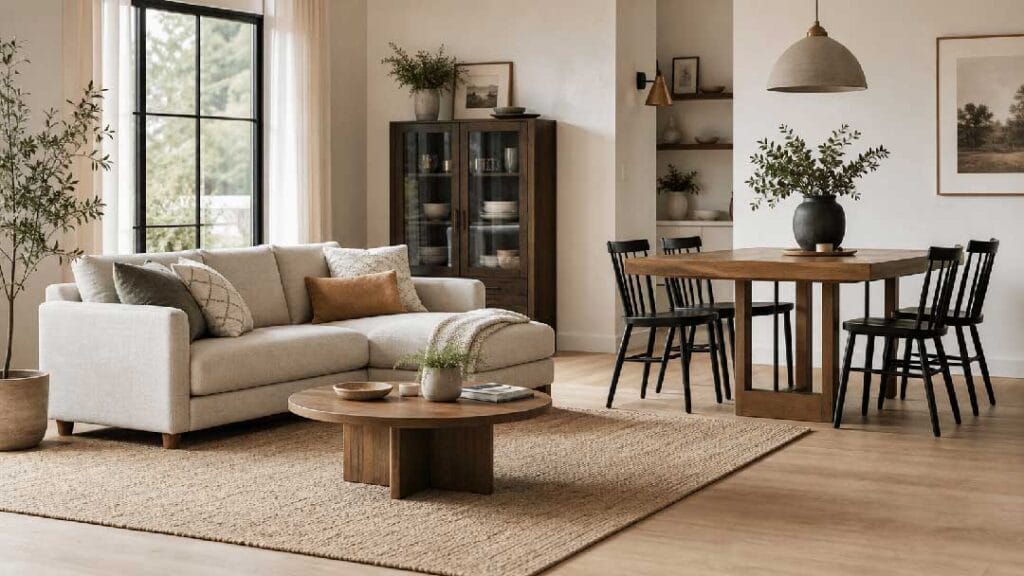
In a store, the moment a customer sits down is the easiest part to be brushed off. A customer plops down, says something like "it's a bit soft" or "it's quite comfortable," and the salesperson chimes in with "it's down-filled," and the sale often hinges on those few seconds. But what truly determines whether a sofa will still be comfortable three to five years later is how the layers of material inside the seat cushion are arranged and what each layer does, not what's written on the label.
They're all called down-filled sofas, but some sell for 20,000 yuan while others cost 4,000 yuan. The difference in comfort can be greater than the price difference. The reason isn't mysterious: the down only provides the surface feel; what truly supports the body is the density of the foam, the structure of the springs, and the webbing in the base frame. By breaking these down, the seating comfort becomes something to discuss and judge.
The seating comfort is achieved through a combination of four dimensions, not just two levels of firmness.
Crudely categorizing seating comfort into soft and hard is a lazy approach shared by both consumers and sales staff. The actual experience consists of at least four dimensions.
- supportIs your body weight being evenly supported? Are your lower back and tailbone unsupported? A sofa with insufficient support may feel comfortable for ten minutes, but after an hour, your back will ache.
- rebound speedHow long does it take for the seat to return to its original shape after you get up? A material with slow rebound will make you feel like you're sinking in and can't get out, while a material that rebounds too quickly will make you feel like you're sitting on a gymnastics mat.
- Enveloping feelingCheck if the shoulders, back, and leg hollows are properly covered by the fabric and outer layer; this is where down feathers excel.
- Breathability and temperatureWhether your back feels stuffy and sweaty after sitting for half an hour in summer depends on the breathability of both the fabric and the filling; the thicker the filling, the easier it is to retain heat.
Add another time dimension: durability. The comfort of a new sofa is of limited value; what really matters is how much support it retains after three years. This is why disassembling the materials is more meaningful than sitting on it for ten minutes.
Sponge: Density, hardness, and resilience are three things; don't just look at one number.
The term "high-density foam" is most frequently heard in stores, but density, firmness, and rebound are actually three independent parameters. Density determines the load-bearing capacity and resistance to collapse, with common specifications falling between 25 and 45; firmness determines whether the seat feels soft or firm when you sit down; and rebound speed determines whether the seat surface sinks slowly or holds up immediately. High density does not equal firmness, and low density does not equal softness; the three can be combined in any way.
A common practice with low-priced sofas is to use low-density foam for the thick cushions. They're soft and fluffy when you first buy them, but after six months, dents appear in the same spots. Consumers often mistake these for normal wear and tear, but the problem lies in the choice of materials. The method to determine this is simple: press firmly on the center of the seat cushion with your palm for ten seconds and release. Observe the speed of recovery and whether a noticeable dent remains. Then press the edge of the cushion and compare it to the center. A significant difference in depth indicates poor layering or insufficient reinforcement at the edges.
Another type that's easily confused is slow rebound foam, also known as memory foam. It rebounds extremely slowly and conforms well, but using the entire layer can be stuffy and make getting up difficult. In the industry, it's usually only used as a thin bonding layer or in backrests, rarely as a whole piece for the main load-bearing layer of a seat cushion. If you see an advertisement for a whole piece of memory foam seat cushion, first think about how it would feel to sit on it in the summer.
Down: Offers the best wrapping feel, but doesn't provide enough support.
Sitting on a down-filled sofa gives you the feeling of sinking in first and then being caught – a common technique used in high-end sofas. However, pure down offers almost no support, and using a single layer as a seat cushion presents three problems: you sink right in, you need to brace yourself when you get up, and the down tends to bunch up to the sides. Therefore, the mainstream approach is a composite structure, with a thin layer of down on top for the outer layer and coverage, and high-resilience foam underneath for the lining.
When buying a down sofa, the key questions aren't whether it contains down, but rather which layer the down is in, how thick it is, and whether it's divided into sections. The more sections, the less likely the down will bunch up at the edges, preventing a noticeable difference in thickness from thin in the middle to bulging at the sides after prolonged use. Also, note that furniture down fillings are generally not labeled with the same down content standards as down jackets. Focus more on the filling weight, the quality of the down, and the down-proofing treatment on the fabric. Cheap products with a lot of feather shafts and dust in the filling will not only feel rough to the touch but may also experience down leakage and unpleasant odors with long-term use.
Another drawback of down is its susceptibility to moisture. In southern regions during the rainy season, coastal areas, and poorly ventilated homes, down bags tend to absorb moisture and clump together, requiring regular airing and beating. For families who cannot do this, a combination of a down outer layer and a sponge core is more convenient than pure down.
Cotton plush toys: Cheap doesn't mean bad; it depends on where you put them.
Doll cotton is a common name for three-dimensional hollow polyester fiber. It is low in cost, fluffy quickly, and has a pleasing initial feel, making it widely used in cushions, armrests, and low-priced seat cushions. Its drawback is that its elasticity diminishes quickly, and it tends to clump after prolonged pressure.
However, it's unfair to condemn plush toy foam outright. It's a reasonable choice for backrests—fluffy, lightweight, and cost-effective—and backrests don't need to bear weight anyway. The problem lies in using it as the main load-bearing layer for seat cushions. A sofa with an entire layer of plush toy foam will be very fluffy for six months, but then you'll see a contrast between the thinner seat area and the bulging edges, and it's very difficult to restore its shape by patting it.
Be wary of claims like "down cotton," "space cotton," or "pearl cotton." These are mostly variations of polyester fibers or marketing terms, and are not the same as down. Their comfort and durability are also incomparable.
Springs, bandages, and the base: the truly overlooked underlying structure
Beneath the seat cushion lies another structure that determines whether the sofa will sag in the middle or tilt upwards at the ends. Common solutions include serpentine springs, individually pocketed springs, and elastic webbing.
Individually pocketed springs provide zoned support, allowing two people to sit on the same sofa without disturbing each other, and turning over won't cause the person next to them to sway. These are the most expensive type and are often found in mid-to-high-priced products. Snake springs paired with webbing are the most common combination in mid-range sofas in China. A well-made snake spring can last for many years, while a poorly made one will show signs of wear within two years. The key to judging its quality lies in the number of springs, the tension of the webbing, and the presence of lateral reinforcement stitching.
When trying out the seat, you can do a few simple things: sit down and listen for any metallic creaking sounds; stand up and check if the seat surface recovers evenly; press down on the four corners of the seat cushion and compare them to the center; lift up the seat cushion and check if the bottom webbing is loose or has obvious indentations. These actions are not professional, but they are more effective than listening to the salesperson explain the material terms.
Common Fill Combinations Comparison
| Structural Combination | Sitting characteristics | Suitable for | Need to pay attention |
|---|---|---|---|
| Full layer of plush cotton with serpentine springs | It initially felt soft but then collapsed; it offered a strong sense of envelopment but weak support. | Transitional use, rental property, limited budget | The seat height difference becomes obvious after one or two years. |
| Ordinary sponge plus bandage | Slightly stiff, quick rebound | I am used to sitting upright and mainly entertaining guests in the living room. | Insufficient sponge density can easily lead to localized collapse. |
| High-resilience sponge with down outer layer | Soft first, then supportive, balancing wrapping and support. | The main sofa in most households | The down layer needs to be patted and aired out regularly. |
| Layered sponge with individually pocketed springs | Zone support, quick and easy rise | High requirements for comfortable seating and shared by multiple people | The price is high; it needs to be confirmed that it can be replaced. |
| Full down seat cushion | Ultimate wrapping, weakest support | Short-term leisure, secondary bedroom and media room | Difficult to get up, prone to clumping, and susceptible to dampness |
Price range: What you actually get with different budgets
With a budget of two to three thousand to five thousand, these products typically consist of a full layer of plush cotton or medium-to-low density sponge with serpentine springs, and the cushions are made of plush cotton. These products aren't necessarily bad, but it's important to understand that they are intended for transitional use; don't expect them to last for more than five years.
The 6,000 to 15,000 yuan price range is currently the most competitive segment. High-resilience foam composite seat cushions, down or doll-cotton top layers, and serpentine springs with webbing are standard features, with some products starting to use individually pocketed springs. The key difference at this price point isn't the type of material, but rather the thickness of the material and the details of the workmanship. Even with the same high-resilience foam, a difference of just two centimeters in thickness can make a world of difference in seating comfort.
Sofas priced above 20,000 yuan often feature layered foam combinations, individually pocketed springs, better fabrics and frames, and service-oriented designs such as replaceable seat cushions. It's important to note that price and materials are not linearly related; fabric, design, and brand premium account for a significant portion of the cost, and the same filling structure can have substantial price differences across different channels. When considering materials, it's also crucial to check which channel the sofa is sold through and what after-sales service guarantees it offers.
What can you find out in five minutes at a store?
- Sit upright for three minutes, and don't sit down and immediately get up. Three minutes is enough to feel whether your lower back is unsupported and whether your knees are being compressed.
- Backrest test: Lean back and see if your shoulders and back are supported, and whether the backrest is pressed all the way down.
- Standing test: Without using your hands for support, see if you can stand up smoothly. This test is especially important for the elderly.
- Edge sitting: Sit on the outermost edge of the seat cushion and feel if it will slide down, and whether the edge is reinforced.
- Tap the seat cushion: listen to whether the sound is muffled, check whether the rebound is even, and feel for any hard lumps at the seams.
- Ask two questions: What is the density of the foam, and what kind of spring structure is used? Salespeople who can answer clearly usually know what they are selling; be wary of those who only repeat the word "down."
Different families have different choices.
- For families with elderly members: Avoid seats that are too low or too soft. A moderately high seat height and slightly firmer foam are more comfortable, as they need support when getting up. Pure down seat cushions are not suitable.
- For families with children: Prioritize removable and washable materials and durable fabrics; filling is secondary, as children will eat, jump, and spill water on the sofa.
- For pet owners: Fabric is a higher priority than filling. Durable and easy-to-care-for fabrics such as fleece and technical fabrics can save a lot of cleaning time.
- In humid southern regions: the thickness of the down layer should be carefully selected or controlled, and attention should be paid to ventilation and drying conditions, as moisture is the biggest enemy of down.
- For small living rooms: Don't go overboard with deep seats. Sacrificing passage space to lie down is a common mistake. Modular designs with replaceable cushions have lower maintenance costs in the long run.
What are the challenges of selling sofas online? Seating comfort is a parameter that cannot be photographed.
In recent years, online sales of sofas have increased, but the pain points of returns and exchanges have always centered on two issues: unsuitable size and seating comfort that does not meet expectations. Pictures can capture the color and shape, but they cannot capture how quickly the foam rebounds, nor can they capture how much effort it takes to get up after sinking in.
As a result, several significant changes have occurred in the industry. First, replaceable seat cushions have gone from being a selling point to becoming a standard feature; replacing a collapsed cushion is more cost-effective than scrapping the entire sofa. Second, modular design allows small apartments to be assembled according to living room dimensions, thus reducing return rates. Third, while offline experience stores and live-streamed try-on sessions have taken on some of the experiential functions, the actual sitting feel still highly depends on people being physically present at the store.
For consumers, a reasonable strategy for buying sofas online is to order the style, fabric, and size online, clarify the seating comfort parameters as much as possible, and prioritize vendors that offer individual seat cushion replacements and longer trial periods. For dealers, replaceable seat cushions are not just a service, but also a means to reduce after-sales costs and create secondary sales opportunities.
Some judgments for product selection and sales guidance
If stores only compare price ranges when selecting products, they will eventually fall into homogenization. What's more worthwhile to compare is what the sofa will be like three years from now: has the foam sagged, has the down clumped, are the webbing loose, and can the seat cushions be replaced? In after-sales repairs, seat cushion sagging and fabric damage account for a significant proportion, and both of these can be avoided in advance by assessing the materials used during the product selection stage.
Sales pitches don't need to be filled with material jargon. Instead of talking about high-density foam, say that this sofa supports your lower back when you sit down, you don't need to use your hands to prop yourself up when you get up, and the seat cushions can be replaced individually after three years. Translating the materials into usage scenarios often leads to a higher closing rate than simply reciting specifications.
There's no standard answer to the question of seating comfort; it's all about personal preference. Some people enjoy the feeling of being enveloped and comfortable, while others experience back pain when sitting on a soft sofa. The key is to consider your own body and usage habits, not what others say about high-end materials.
nkfurn has long focused on the structure and materials of furniture products, as well as spatial arrangement and real-world market changes. From the layering of sofa fillings to cabinet materials, from store product selection to consumer trends, nkfurn is willing to lay out these visible and invisible details to help those choosing furniture avoid some detours and help those in the furniture business make more solid judgments.
Further Reading
If you are systematically planning your furniture selection or market content, you can also continue reading these related articles:
- Where does the price difference between solid wood veneer and solid wood go? A reconciliation of the base material, craftsmanship, and price range.
- The "face" of solid wood furniture: How to choose between wood wax oil, varnish, and open-pore finish without making a mistake?
- Sofa Comfort and Durability: How to Choose Fillings and Fabrics to Avoid Disappointing Choices
- Why are fully removable and washable fabric sofas becoming increasingly rare in the mid-range price segment? Factors include cost, fabric quality, and actual usage costs.
- The true grading of edge banding processes: Where do the differences in cabinet odor, durability, and price come from?