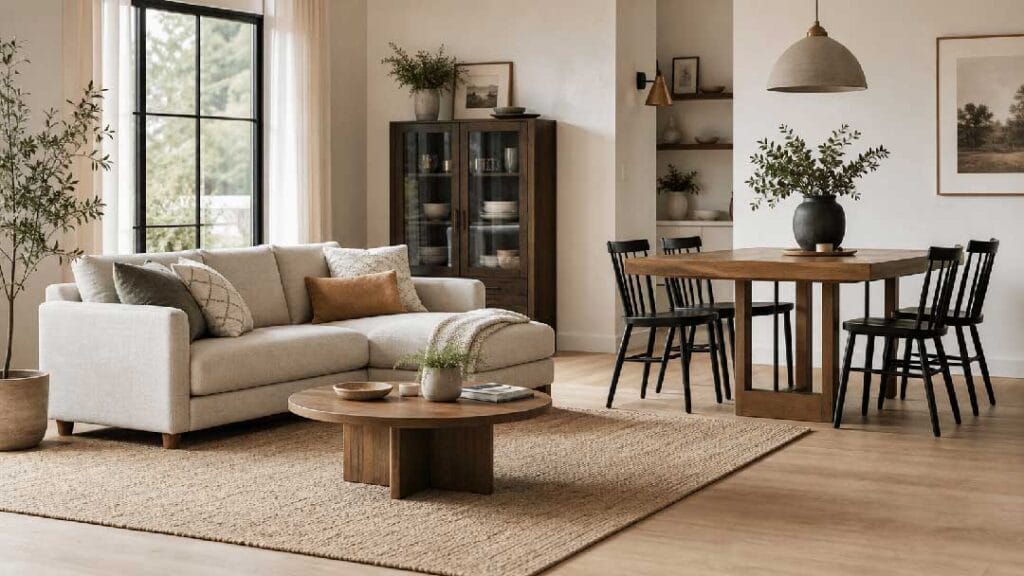
After visiting a few sofa stores, you'll notice a change: when sales staff introduce fabric sofas, they're less likely to proactively mention that the entire set is removable and washable. Instead, they'll say the fabric has a stain-resistant treatment and you can just wipe it with a damp cloth if it gets dirty. A few years ago, however, removable and washable was practically a standard selling point for mid-range fabric sofas. The ability to remove the entire sofa cover and put it in the washing machine was a major reason why many families placed an order on the spot.
This selling point hasn't disappeared, but it has indeed relegated to a secondary position in the mid-range price segment. The reason isn't a single aspect, but rather a simultaneous change in fabric structure, pattern-making processes, labor costs, after-sales risks, and consumer habits. Breaking it down will be more meaningful than simply saying the manufacturer has cut corners.
First, consider the fabric: the prerequisite for being detachable is that the dimensions are stable.
Removable and washable covers require a higher level of fabric quality than fixed covers. Fixed-cover sofas are stretched and nailed in the factory; any slight shrinkage or elasticity in the fabric can be absorbed by the stretching and filling. Removable covers, however, must be able to be put back on after being removed, washed, and dried. This requires the fabric to undergo thorough pre-shrinking treatment before cutting, ensuring stable weight, similar warp and weft shrinkage rates, and colorfastness that can withstand multiple washes.
The fabric structure of mid-range upholstered sofas has changed significantly in recent years. The proportion of technical fabrics, imitation cotton and linen, chenille, and various types of velvet products has increased. These fabrics share the characteristics of a similar feel, textured surface, and controllable unit price. However, the dimensional stability and washability of some categories are not ideal. This is especially true for high-grammage velvet and jacquard fabrics with obvious textures, which are significantly more likely to experience pile flattening, texture misalignment, and edge wrinkling after washing. Fabric manufacturers are willing to perform pre-shrinking and shaping, but each process adds to the price per meter, ultimately reflected in the retail price.
Another aspect is appearance. Dark, solid-color fabrics are generally fine to disassemble and wash completely, but once large repeating patterns, directional pile, or contrasting colors are involved, matching the pattern and orientation after disassembly and reassembly becomes very easy to get wrong. If consumers put it back on crookedly or the pattern doesn't match the first time they try, they'll assume there's a problem with the product. Handling these kinds of complaints is very time-consuming.
What are the main cost components of a detachable sofa set?
Many people think that being washable simply means sewing on an extra zipper, but it actually changes the entire manufacturing process. The table below breaks down the differences quite clearly; note that this refers to relative relationships, not absolute numbers.
| Link | Full disassembly and washing method | Fixing sleeve method | Impact on terminal prices |
|---|---|---|---|
| Fabric preparation | Pre-shrinking and setting are required, and stricter color difference control is needed within the same batch. | You can directly cut it online. | Significantly raised |
| Pattern and Cut | Allow for slack during disassembly and assembly; lay out the inner liner and outer liner separately. | Lay out the pattern while it is taut, with minimal loosening. | moderate elevation |
| sewing | Invisible zippers, binding, and concealed stitching require a long production time. | The main method is fixation and suturing. | Significantly raised |
| Inner liner matching | The sponge and the outer cover need to be fitted with tolerances to prevent them from not fitting together or wrinkling. | High tolerance | moderate elevation |
| Hardware and accessories | Zippers, Velcro, and buckles are used extensively and need to be durable. | Small dosage | Slightly raised |
| Inspection and after-sales service | Disassembly and reassembly verification is required, and after-sales service should guide users to reassemble the device. | This step is basically nonexistent. | High hidden costs |
Stacking all these up would significantly increase the manufacturing cost and repair risk of a three-seater fabric sofa if it were truly designed for complete disassembly and washing. In the mid-range price segment, this is often an insurmountable hurdle.
The section between 3,000 and 6,000 was the first to be cut.
The main sales market for fabric sofas in China is concentrated in the 3,000 to 6,000 yuan price range, with online promotions and offline stores primarily focusing on this segment. Consumers in this price range are characterized by high price sensitivity, low tolerance for minor details, and easy price comparisons of similar products. Furthermore, the cost structure in this segment is increasingly complex, with rising costs for fabrics, foam, shipping, platform commissions, and store rent, leaving factories with limited room for maneuver.
To maintain profit margin at this price point, the items that can be reduced fall into a few categories: internal frame materials, foam density and quality, hardware grade, fabric weight, and removable/washable structures. Consumers can't see the first few items, while removable/washable structures are visible but used infrequently, making them the easiest to sacrifice. Conversely, custom sofas priced above 8,000 yuan, imported brands, and designer models are more likely to retain full removable/washable construction because this customer segment has clear expectations regarding cleaning and maintenance and is willing to pay for craftsmanship.
Online channel rules have further exacerbated this trend. "Fully washable" is a strong promise; once a product page states it's washable, consumers will assume it's machine washable. Shrinkage after washing, zippers breaking, or the item not fitting back on will all result in returns and negative reviews. For merchants already sensitive to return costs, downplaying this promise and changing it to "stain-resistant and easy to wipe" is a lower-risk approach.
Consumers also have three common misjudgments.
Detachable does not mean machine washable.
In the industry, "removable and washable" usually refers to outerwear that can be removed for dry cleaning or gentle hand washing in cold water. Only a minority of fabrics can truly withstand tumble washing and repeated tumble drying; this requires the fabric, seams, zippers, and lining to all be compatible. In a store demonstration, it might be easy to disassemble by hand once, but after washing it three times at home, the feel is completely different.
Detachable does not mean it will be disassembled frequently.
Removing the full cover from a three-seater sofa results in a large pile, requiring space to dry and taking two people at least half an hour to put it back on. The percentage of households that actually remove and wash the covers quarterly is not high; most people buy it for peace of mind but rarely remove them even once a year. This gives manufacturers reason to believe that the actual value of this feature is overestimated.
Demountable does not mean easy to maintain.
Removable covers typically have more seams and looser upholstery, making them prone to shifting and gaping after prolonged use. Fixed covers, on the other hand, rely on tension for a more structured look. For modern styles that favor clean lines, fixed covers are often more aesthetically pleasing over time.
Now, if you still want to buy a removable and washable one, in what situations is it worthwhile?
- For families with preschool children or pets who need to deal with milk stains, footprints, scratches, and odors daily, the convenience of a detachable and washable appliance is both psychological and practical.
- If the house is rented or short-term rental, the furniture will be moved around several times with the owner. Being able to disassemble, wash, and replace the covers means extending its lifespan.
- In humid southern regions, clothing needs to be thoroughly washed and aired after the plum rain season to prevent musty smells from accumulating.
- I chose light-colored, off-white, and cream-colored fabrics, which require a lot of daily maintenance. The removable and washable design is an extra layer of protection.
- Modular sofas and Japanese-style low-back sofas, which have many components, are not much more difficult to manufacture as washable, and offer better value for money.
Conversely, if your home features dark, dark gray, or textured fabrics, and you primarily use vacuuming and spot cleaning, the extra money spent on removable and washable surfaces may not be worthwhile. It's better to allocate your budget to comfort and internal frame structure.
To determine whether a sofa is worth the extra cost for washable features, consider these points.
- Make sure to clarify whether it's a fully detachable or partially detachable system. Detachable seat cushions and backrests are common, but whether the armrests, base, and outer frame can be detached is the key difference.
- Unzip the zipper to see the inner lining. If there is a non-slip lining between the outer layer and the foam, and the inner lining is independently wrapped, re-sleeving will be much easier.
- Examine the zipper's location and workmanship. If the zipper is hidden in the back fabric or on the back side, or if it is covered by binding, it indicates that it was carefully designed and not added on the spot.
- Ask about the fabric's washing instructions. Legitimate products will indicate whether they are dry-cleanable, hand-washable in cold water, or not washable. Be wary of products that only state "removable and washable" without specifying washing instructions.
- Try disassembling and reassembling one seat cushion at the store to check if the looseness is reasonable and if there are any obvious wrinkles when it is put back on.
- Confirm after-sales service. Many stores will avoid mentioning whether issues like damaged covers, shrinkage, or broken zippers are covered under warranty.
Alternative approach: Solve cleaning anxiety without removing the cover.
In recent years, the main trend in fabric finishing has been three-proof treatments: waterproof, stain-resistant, and oil-resistant, allowing for easy wiping away of everyday spills. While this type of treatment does reduce the difficulty of immediate cleaning, its effectiveness diminishes with use and washing, typically requiring reassessment every two to three years. It addresses what to do when something gets dirty, not what to do when it's completely stained; the two are not the same thing.
Another approach is modularity in structure. The product logic is to make sofas into replaceable sets. Customers choose a main set when buying, and then buy a replacement set a couple of years later, at a much lower price than buying a whole sofa. This approach requires high standardization of the manufacturer's designs, but it's more practical for consumers and also solves the problem of aesthetic fatigue. Currently, it's not yet widespread in the domestic mid-range market, appearing more often in designer brands and export-to-domestic product lines.
The simplest solution is to use sofa blankets, sofa cushions, and washable pillowcases. These don't solve the problem of cleaning the entire sofa, but they can cover the seats and armrests, which are most prone to getting dirty, and the cost is almost negligible.
Some practical suggestions for stores and distributors
The biggest problem with the "removable and washable" feature is its vague description. If the product page says it's removable and washable, the store says it is, and after-sales service says it's not covered under warranty, these three conflicting statements can easily lead to disputes. A safer approach is to clearly indicate the removable/washable levels: fully removable, removable seat and backrest, removable seat cover only, and non-removable—clearly stating these four levels and providing a disassembly/reassembly diagram. This won't deter customers; instead, it will reduce arguments.
There's also an art to sample display. If the sofa in the store has been disassembled countless times, and the cover is loose and wrinkled, it will ruin the customer's first impression of the product. For removable and washable samples, it's best to change the cover and rearrange it regularly, or only keep one seat cushion as a demonstration piece, while the rest remain intact. When demonstrating, slow down your movements so customers can clearly see the zipper location and the difficulty of re-sleeving; this is more effective than stating ten selling points.
From an industry perspective, the decline of washable sofas isn't a sign of technological regression, but rather a result of different trade-offs at different price points. In the mid-range market, stain-resistant fabrics and easy-care construction have been used to lower the price threshold and reduce after-sales risks. The high-end market continues to retain full washability, while the middle segment has seen a proliferation of semi-washable options. Understanding this stratification is more helpful in making the right choice than obsessing over whether a particular sofa can be disassembled.
nkfurn focuses on the structure, fabric craftsmanship, and spatial arrangement of furniture products, while also keeping up with changes in channels and price ranges. The content on the platform tends to place products in real-world usage scenarios, helping consumers and industry professionals understand why a piece of furniture is priced and designed in a certain way, and in what kind of home it is more suitable for.
Further Reading
If you are systematically planning your furniture selection or market content, you can also continue reading these related articles:
- Why Nankang Is China’s Furniture Manufacturing Hub
- A sagging mattress doesn't necessarily mean the mattress itself is the problem: A proper assessment of the spacing and structure of a solid wood bed frame.
- Are solid wood dining tables being unfairly blamed for cracking? Whose market is being stolen by slab stone dining tables? — The truth about materials, craftsmanship, and price when buying a dining table in 2025.
- Most cracks in solid wood furniture are caused by defects that were present before the furniture left the factory.
- A grand event combining two exhibitions! The first major exhibition of the 2026 China Home Furnishings Year will be held from March 6th to 9th, jointly exploring new blue ocean markets for domestic home furnishings sales!