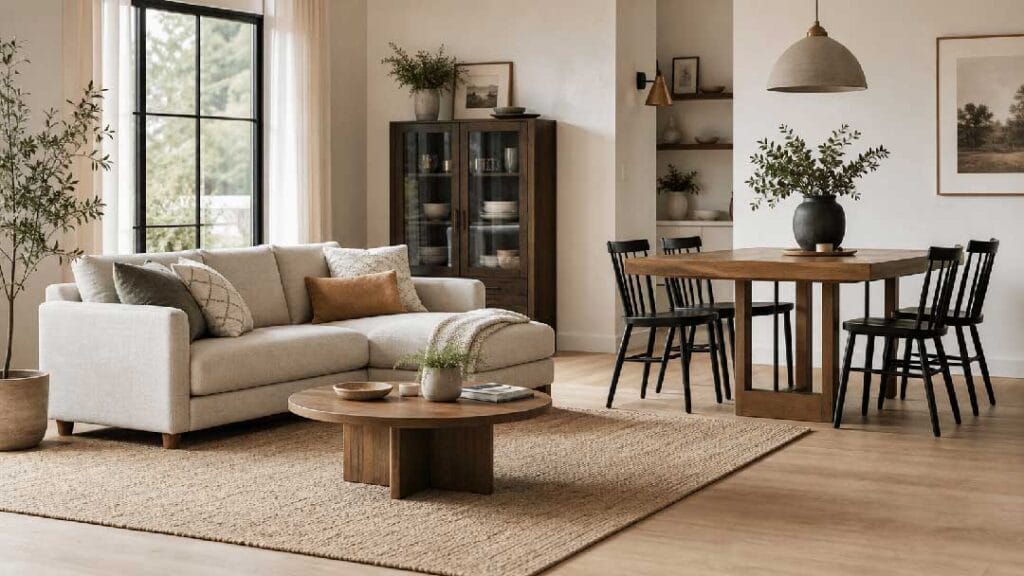
In stores, you often see this scene: two "solid wood dining tables," similar in size and color, one priced at around two thousand, the other at five thousand or more. The sales assistant's explanation usually stops at "this one is straight-jointed, that one is finger-jointed," and they can't provide any further details when pressed. For buyers, this is meaningless; for dealers, this is precisely where they are most likely to be stumped and where after-sales service issues most likely arise. Where exactly does the price difference lie? It all starts with explaining how the tabletops are joined together.
First, distinguish between these three terms: direct spelling, finger connection, and skin-attached.
direct pinyinThis involves planing and trimming several strips of wood, applying glue to the sides, and then pressing them flat into a wide board with straight seams between the strips. The industry term "large board straight splicing" refers to using wider strips and fewer seams to create an effect close to a single board. The wider the strips and the fewer the seams, the higher the requirements for the logs, and the higher the price.
finger jointThis involves milling toothed tenons into both ends of a short piece of material, interlocking the ends, and pressing them together to form a long piece, which is then assembled side-by-side into a board. Its significance lies not in "saving glue" or "downgrading," but in transforming short, scrap, and small-diameter materials into usable long pieces. The joint of a toothed joint is an end-to-end connection; its strength relies on the interlocking teeth and the glue layer, visually leaving regular horizontal tooth patterns on the board surface.
Veneer and FinishIt's a completely different approach: the core material is plywood, particleboard, or engineered wood, with a surface veneer of solid wood, engineered wood, or melamine. It can create very beautiful continuous grain patterns and the price is lower, but it's not the same issue as "solid wood veneer." The most common source of controversy in stores is calling veneer panels solid wood slabs and finger-jointed boards solid wood slabs.
There is another type of thing that lies in the middle—GlulamAlso known as finger-jointed board or spliced material, it is mostly used for tabletops, shelves, and bed slats. It is stable, inexpensive, and easy to process; the only drawback is its limited potential for improved appearance and texture. Understanding the purpose of these materials makes the price differences less of a mystery.The high price isn't due to the word "solid wood," but rather the proportion of usable material and the skill in selecting it.
The biggest difference in price lies in the yield rate.
Long, wide, and short materials represent two different cost worlds.
A 1.6-meter dining table typically has a tabletop width of around 80 centimeters. If it's a straight-jointed table, the common practice is to use four to six strips of wood, meaning each strip must be nearly the length of the table and wide enough. When sawing logs, knots, cracks, rot, and blue stain must be avoided. The proportion of logs that can be cut to these specifications is not high; the rest must be used at a lower grade. Low yield means high unit price—this is the most basic cost logic in wood processing.
Finger-jointed boards have a much wider range of raw material sources: short pieces, scraps, and even secondary materials can be used. As long as the tenons are cut neatly and the moisture content is controlled, the resulting boards are not inferior in strength and stability. In fact, because the internal stress is broken down and reassembled, their resistance to deformation is even better than that of wide boards joined directly. Therefore, finger-jointing is not "cutting corners"; it is a different product positioning—using lower raw material costs to achieve a more stable structure, at the cost of appearance and feel.
Drying and health benefits are factored into the price but not visible.
Why do some boards made from the same material sell for over 3,000 yuan while others sell for 8,000 yuan? A large part of the difference lies in the drying process. After the logs are sawn into boards, they need to be dried in a kiln to control the moisture content within a range that matches the climate of the area where they will be used. After leaving the kiln, they need to be stacked and cured for a period of time to release internal stress before processing. If the curing time is insufficient or the drying curve is too rapid, the problems with the boards may not be visible at the time, but after six months to a year, they will start to warp, crack, and the seams will widen.
Consumers in stores can only see the finished product; they can't see how long the raw materials spent in the kiln or how many months they were stored. This creates a mismatch:Factories willing to spend more money on drying may not produce products with a more stunning appearance, but they will command higher prices.Its returns won't be apparent for one or two years, which coincides with a peak period for after-sales disputes. When distributors select products, if they only compare appearance and price, they can easily end up choosing a batch where the drying process has been compromised.
Several key performance indicators that truly affect the usability of panel manufacturing processes
Slat width and probability of deformation
The wider the slats, the more luxurious the materials used and the more complete the grain, but the greater the amount of shrinkage and expansion of each slat due to moisture, and the more noticeable the displacement at the joints. In practice, narrower slat tabletops are more compliant, while wide, straight-jointed tabletops are more aesthetically pleasing but more dependent on the environment. The same wide tabletop may perform completely differently in heated rooms in northern winters and during the rainy season in the south. This is why some factories that make high-end tabletops add dovetail grooves and webbing on the back to mechanically constrain panel displacement.
seams, glue, and straps
When inspecting the seams, first check for flatness, obvious glue lines, and color variations or breaks. Blackened glue lines or gaps that can be scratched with a fingernail indicate problems with pressure or glue application during bonding. Turn the table over and examine the back: check for webbing, anti-deformation grooves, and whether the legs are connected to the tabletop with metal or wooden tenons. These details determine whether the table can last for ten years.
Environmental considerations are also worth mentioning. While the amount of glue used in splicing is relatively small compared to processing whole boards, the types of glue and lamination processes differ significantly: urea-formaldehyde glues are low-cost but difficult to control in terms of odor and release; modified glues, MDI-based glues, and some glues specifically designed for splicing are more expensive. Domestic wood-based panels have a clear formaldehyde emission limit system; when purchasing, checking test reports and grade labels is more reliable than relying on verbal promises. It's important to note that the odor of finished furniture comes not only from glue but also from coatings, edge banding, and packaging materials; judging solely by "whether there is a smell" is inaccurate.
The number of paint coats determines the first year's appearance.
The cost and effect of wood varnish, wood wax oil, and UV coating vary greatly. A common practice with low-priced dining tables is to use a thin base coat and minimal topcoat. While the color may be uniform when first manufactured, after a few months, whitish wear rings and water stains appear on the surface. Tables with a thorough coating show significantly better stain and scratch resistance in the first two years. This cost difference is difficult to discern in stores, but it represents a substantial difference between a table costing five thousand and one costing eight thousand.
Judgments that can be made at the store and upon receiving the goods.
- Examine the cut surface at the end of the desktop panel: whether the growth rings are aligned and whether there are obvious end-to-end joint marks can quickly distinguish between straight splicing and finger splicing.
- Count the seams: For a 1.6-meter tabletop, a significantly higher number of seams usually indicates that narrow strips of material were used.
- Observe the color difference distribution: It is normal for natural wood to have color differences, but straight-jointed boards are sorted and matched for color before leaving the factory. If the color difference is too large, it is often because the sorting process has been skipped.
- Feel the seams: If you can feel unevenness when you run your finger horizontally, it indicates a problem with sanding and bonding. This type of tabletop is more prone to problems after changes in humidity.
- Check the back: whether there are straps or anti-deformation structures is a quick way to judge whether the table is well-designed.
- Stores that cannot answer questions about moisture content and applicable regions usually lack a stable drying system.
- When receiving the goods, do not inspect them under dim lighting. Try to check for color differences and scratches under natural light or white light. The store's spotlights will make dark wood appear more uniform.
In what situations is finger jointing a reasonable choice?
If your budget is between two and four thousand, and you want genuine solid wood rather than veneer, finger-jointed or engineered wood tabletops are a practical choice. They offer good stability, withstand minor bumps and knocks, and are more convenient than wide planks for families with children, rental properties, temporary offices, or situations requiring frequent movement. Conversely, if your dining table is intended for long-term use, you want a consistent wood grain, and you value color variation and texture, then the extra money you spend is primarily for material selection and drying, not just the "solid wood" label.
Another point worth noting: for tables used outdoors or semi-outdoors, whether they are joined by straight panels or finger joints, it's crucial to check if the structure includes drainage and expansion/contraction space. Many complaints about tables cracking after only six months of use are not due to the panel joining method, but rather the lack of space allocated for the wood in the design.
Price range and distribution channels: What you can actually buy with different budgets
Roughly categorizing solid wood dining tables on the market reveals the following relationships: The entry-level segment primarily uses finger-jointed boards, engineered wood, and veneer panels, with wood species mostly including rubberwood, pine, or fast-growing timber. Its selling point is "solid wood feel and affordable price." The mid-range segment begins to feature narrow, straight-strip designs, with wood species shifting towards ash and oak. Finishes and hardware are noticeably more upscale, making this the most competitive segment. The mid-to-high-end segment features wide, straight-strip designs, color matching, interlocking weaves, and branded finishes, emphasizing long-term reliability. Above that lies the realm of large slabs, single-piece planks, unique grain patterns, and custom sizes, where price flexibility is extremely high.
Channel differences are equally significant. Online white-label brands rely on pictures and specifications to sell their products, making it difficult to convey the differences in paneling processes. Price wars often end with reducing panel width and the number of coating coats. Regional factories win by offering local services and samples, and are willing to invest more in drying and structural design. A significant portion of the premium offered by brand stores comes from after-sales service and stable supply. When assembling their products, distributors should ideally stock both finger-jointed and direct-jointed models simultaneously, catering to different customer groups at different price points, rather than packaging finger-jointed models as direct-jointed models—such sales tactics, once exposed, damage the trust of the entire store.
A reminder for buyers and purchasers
The price difference in solid wood dining tables essentially stems from a series of unseen trade-offs: how much high-quality material is available, how long the wood has been in the kiln, the width of the planks, whether or not crossbeams are added to the back, and how many coats of finish are applied. These trade-offs are almost imperceptible in finished product photos, yet they directly determine how the table will look three years from now. Buyers should ask more specific questions, and dealers should explain the differences clearly, rather than simply attributing all products to the word "solid wood."
Also, don't overlook the logistics aspect. Panel-structured desktops are large and fragile items; proper packaging methods, such as corner protection, panel cushioning, and upright transport, will all affect the breakage rate. If you find obvious signs of compression on the outer packaging upon receipt, it's best to open the box and inspect the goods on the spot, as it's often difficult to clarify the situation later.
nkfurn focuses on furniture products, spatial arrangement, materials and craftsmanship, and market changes. It clarifies information that is easily overlooked, such as paneling methods, wood characteristics, price ranges, and channel differences, helping buyers understand why a table is expensive and helping industry professionals explain their products clearly.
Further Reading
If you are systematically planning your furniture selection or market content, you can also continue reading these related articles:
- Why Does Solid Wood Furniture Have a Smell? How Long Does It Take to Disappear?
- The "face" of solid wood furniture: How to choose between wood wax oil, varnish, and open-pore finish without making a mistake?
- Why do rosewood furniture manufacturers favor using raw lacquer? Understanding the "national lacquer craftsmanship" in traditional Chinese furniture.“
- Are power height-adjustable desks a rip-off? A comprehensive breakdown from materials and motors to usage scenarios.
- Common misconceptions about solid wood dining tables: Don't let sales pitches mislead your judgment.