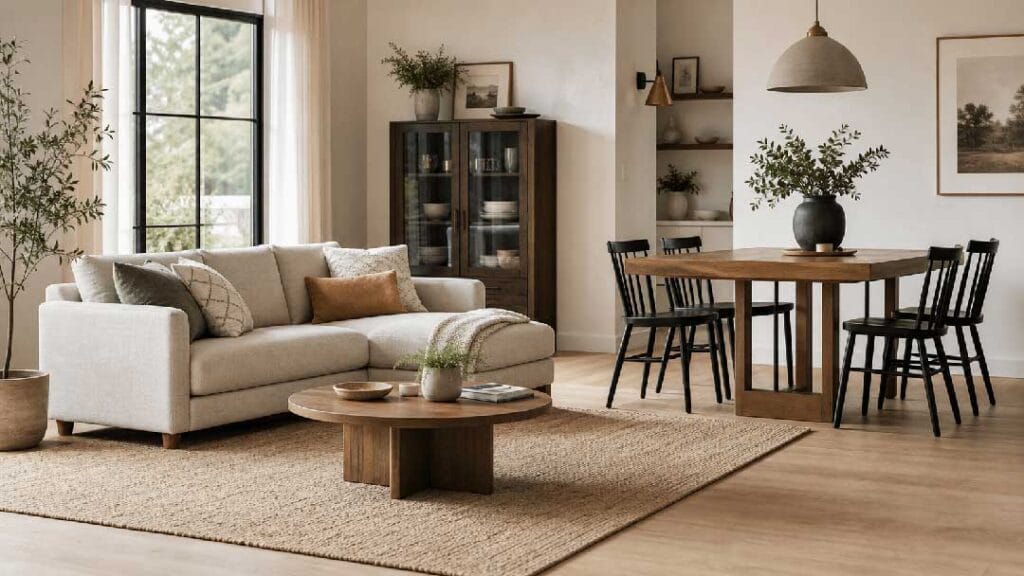
Solid wood dining tables are a top choice for many families when decorating, as they are natural, warm, and durable, and develop unique patinas over time. However, precisely because of their popularity, the market is flooded with marketing claims surrounding solid wood dining tables, such as "all solid wood," "imported timber," and "mortise and tenon structure," making it easy for consumers to fall into traps. This article doesn't intend to repeat basic buying lists, but rather focuses on some of the most common misconceptions to help you build a more solid set of judgment criteria.
Myth 1: Equating the name of timber with the company's advertising
When choosing a solid wood dining table, many people's first question is, "What kind of wood is this?" They then associate oak, walnut, and cherry wood with high-end quality, and pine and rubberwood with cheapness. But the reality is much more complex.
Take oak as an example. The "oak" commonly seen in the market actually includes North American red oak and European white oak. White oak has better performance but is more expensive, while red oak has a coarser grain and a moderate price. More commonly, merchants simply refer to rubberwood as "oak" or sell oak as oak. Rubberwood comes from trees after rubber production; the wood is soft, prone to insects, and has a high sugar content, making it completely different from true oak. If you place an order based solely on the word "oak," you are very likely to receive rubberwood veneer furniture.
Take "walnut wood" for example. North American black walnut is a recognized high-quality hardwood, with a chocolate color and elegant grain, but it is very expensive. Many merchants will call walnut wood, or even stained birch, "black walnut," at only a third of the price. The key is not the price, but whether you are willing to pay for genuine black walnut. If you think you're getting black walnut at a cheap price, you've probably fallen into a naming trap.
Recommendation: Don't just remember the name of the wood; ask for the specific species, origin, and grade. Specific descriptions like "North American Black Walnut FAS grade" or "European White Oak knot-free" are more reliable.
Myth 2: Over-reliance on "whole board" and "single board"“
Many people prefer "single-plank" tabletops when making purchases, believing that a large tabletop made from a single piece of wood is more pure, while a pieced-together tabletop is inferior. This idea has some merit, but it is not comprehensive.
While single-plank wood does have a continuous grain and no seams, giving it a visually impressive appearance, a single plank measuring 80cm wide and 150cm long requires a large tree with a diameter exceeding 90cm, and the tree must be old enough to produce flawless planks. Such wood is not only rare but also has extremely high internal stress, making it prone to cracking and warping due to changes in humidity. A major reason for cracking in solid wood furniture is insufficient drying of the wood or an unreasonable structural design; single-plank wood, lacking the space for expansion and contraction, actually carries a higher risk of cracking.
In contrast, finger-jointed or straight-jointed tabletops, provided the manufacturing process is standardized, not only offer better stability but also allow for the use of smaller diameter timbers, making them more environmentally friendly. Good splicing involves careful matching of colors and textures, making the seams virtually invisible. Some high-end brands even intentionally use splicing to create a symmetrical visual effect.
The misconception is that you shouldn't pay an unnecessary premium for "single-plank" wood, nor should you equate "jointed" wood with low-end products. The key is to look at whether the joining process is refined, whether the glue is environmentally friendly, and whether the wood moisture content meets the standards.
Myth 3: Focusing on wood grade while neglecting the finishing process
Many consumers are willing to spend money on the wood itself, but skimp on the surface finish, or simply don't care. In reality, the finish directly determines the durability, environmental friendliness, and texture of the dining table.
Currently, common finishing methods for solid wood dining tables include: wood wax oil, varnish, polyurethane varnish (PU varnish), and water-based paint. Wood wax oil is natural and can penetrate into the wood fibers, forming an open protective layer. It has a good feel and is easy to repair. However, its hardness and stain resistance are relatively poor; if hot pots are frequently placed on the table or red wine is spilled, marks are easily left. Varnish and PU varnish form a sealed film layer, which is hard and scratch-resistant, but has a plastic-like texture and is difficult to repair once damaged. Water-based paint has good overall performance, is environmentally friendly, and has a smooth feel, but some low-end water-based paints have poor adhesion.
A common pitfall is that merchants claim to use "environmentally friendly wood wax oil," but actually use inferior varnish mixed with pigments. How to tell: Touch the tabletop. If it feels rough like wood, it's likely wood wax oil; if it's smooth like plastic, it's probably varnish. Also, lightly scratch it with your fingernail; wood wax oil will easily leave a mark, while varnish will be harder. However, it's always recommended to prioritize coatings with environmental certifications, such as German natural plant-based wood wax oil or water-based paints.
Another easily overlooked detail is the finish on the back of the tabletop. Many brands, in an effort to save costs, only paint the front and edges, leaving the wood exposed on the back. However, if the back isn't sealed, it will absorb a lot of moisture, causing the entire tabletop to warp. A good solid wood dining table should have a finish on all six sides.
Myth 4: Higher price always means better quality
The price of solid wood dining tables varies greatly, ranging from a couple of thousand to twenty or thirty thousand. The high price is due to factors such as the rarity of the wood, the complexity of the craftsmanship, and brand premium, but a high price does not necessarily mean high quality.
Take a 1.6-meter-long oak dining table as an example: a low-end model might use inferior rubberwood veneer and MDF substrate, selling for 2,500 yuan; a mid-range model uses solid wood (red oak or rubberwood) and costs between 4,000 and 6,000 yuan; a high-end model uses a single piece of North American white oak with imported Italian wood wax oil, and may cost over 10,000 yuan. Doubling the price doesn't necessarily mean doubling the performance, but rather a premium due to design, brand, and scarcity.
More importantly, some high-priced brands spend a significant amount of money on packaging, marketing, and distribution channels, while the products themselves may not be as good as those from small and medium-sized factories that specialize in solid wood. Therefore, judging value should consider raw material costs, craftsmanship, and design content. For example, for the same North American black walnut, FAS grade is more than 30% more expensive than ordinary grade one; mortise and tenon joints are stronger than screw connections but are more expensive; and large-scale straight-jointed boards use more material than small-scale finger-jointed pieces. These are the key factors that determine a reasonable price.
Recommendation: Within your budget, prioritize reputable brands or factory outlets that specialize in solid wood. Ask the seller to provide timber purchase invoices, finish inspection reports, etc. Don't just look at the price tag; break down the cost breakdown.
Myth 5: Ignoring the structure and stability of table legs
Many people focus on the tabletop but overlook the legs and connectors. Besides cracking and warping, the most common quality issue with solid wood dining tables is wobbling. Poorly designed legs or flimsy connectors can lead to loosening after prolonged use.
Common table leg types include: four straight legs, frame legs, and central column legs. Four straight legs have the simplest structure, but require sufficient length and width; legs that are too thin are prone to instability. Frame legs (such as H-shaped or U-shaped frames) are more stable, but take up more leg space. Central column legs are suitable for small round tables, but require a sufficiently heavy base.
An important point to check is the way the table legs are connected to the tabletop. The best option is a tenon or mortise and tenon joint, followed by thickened metal connectors, and the worst is simply screwing self-tapping screws directly into the wood. You can observe this from under the table to see if there are reinforcing crossbeams, if the connectors are sealed with sealant, and if the screws are sturdy. If the seller advertises "mortise and tenon structure," ask to see the actual product or clear detailed pictures, as many so-called mortise and tenon joints are merely decorative details.
Myth 6: Ignoring dimensions and spatial flow
Dining table size is often the last thing many people consider, but in reality, the wrong size can directly ruin the daily experience. Common problems include: buying a 1.8-meter long table only to find that the living room is too small and the aisle is cramped; or buying a 1.2-meter round table only to find that it can't seat 6 people.
A practical reference formula: the width (or diameter) of the dining table should be at least 60cm wide for each person, and the depth (for placing tableware) should be at least 40cm. In addition, the distance from the edge of the dining table to the wall or furniture should be at least 80cm for passage (including the space for chairs to be pulled out). If the dining area is compact, it is recommended to choose a telescopic table or a round table.
Another easily overlooked point is whether the table legs or feet will interfere with the chairs. Some dining table legs are set too far inward, causing the chair legs to get stuck in the middle of the table legs when the chair is pushed in, resulting in wasted space. Therefore, it is best to simulate the chair placement when purchasing, or simply choose a style with inward-curving table legs.
Myth 7: The pursuit of "zero flaws" perfectionism
Solid wood is a natural material, and knots, mineral streaks, and color variations are all normal. Many consumers demand "perfect perfection" when purchasing, which actually forces merchants to use putty to fill in or veneer to cover them up, thus reducing the authenticity of solid wood.
Truly high-quality solid wood furniture retains these natural characteristics and showcases them without compromising the structure. For example, American FAS grade wood allows for knots of a certain size, as long as they are not dead knots (that have fallen off). Mineral streaks are formed by mineral deposits during the wood's growth and can actually enhance the richness of the grain. If you prefer a knot-free tabletop, you can choose the "clean wood" grade, but the price will usually be significantly higher.
Recommendation: When buying in a physical store, you can proactively ask to see the corner with the most flaws to understand how the seller defines "defects." When buying online, you should watch videos of the actual product to avoid being misled by promotional images.
Market Observation: Changes in Solid Wood Dining Table Consumption and Channel Differentiation
From an industry perspective, solid wood dining tables have been undergoing some significant consumer shifts in the past two years. While people previously favored heavy European or Neo-Chinese styles, more and more families are now pursuing simpler, lighter, and more multifunctional designs. For example, tabletops are becoming thinner, table legs are slimmer, and even folding wall-mounted dining tables are appearing.
In terms of distribution channels, solid wood furniture, which originally relied on physical stores, now sees a large number of orders fulfilled through e-commerce. However, a severe polarization has emerged in the e-commerce solid wood dining table market: leading brands, leveraging their supply chain advantages, are becoming increasingly competitive in pricing; while many small and medium-sized sellers are lowering prices by reducing material standards (using spliced boards to imitate solid wood, and veneers to imitate pure solid wood), leading to frequent after-sales problems. When purchasing, consumers must first understand the seller's place of origin and factory background, and then look at follow-up reviews and reviews with pictures.
Another noteworthy trend is the resurgence of "handcrafted customization." Some consumers are willing to spend an extra one or two thousand yuan to have a private carpenter customize the size and style. Although this model has a long turnaround time and no after-sales guarantee, its advantages lie in its uniqueness and high-quality materials. If you have unique requirements for the style, you can also consider this method, but be sure to sign a detailed contract, including the type of wood, drying method, and finish type.
Finally, regardless of the purchase channel, it is recommended to request a sample (of the wood and finish) first, or to conduct a video inspection before purchasing. Solid wood furniture, unlike fast-moving consumer goods, has a high cost for returns and exchanges.
For those considering solid wood dining tables, don't be intimidated by various jargon and artificial grade labels. Let's get down to basics: is the wood itself stable? Is the craftsmanship refined? Is the size appropriate? Is the finish environmentally friendly? Understanding these four dimensions will help you avoid most pitfalls. nkfurn has always focused on changes in furniture products, including advancements in materials and craftsmanship, greater possibilities in spatial arrangement, and increased market transparency. We don't manufacture furniture, but we hope to help consumers and industry professionals make more rational choices through continuous content sharing.
Further Reading
If you are systematically planning your furniture selection or market content, you can also continue reading these related articles: