The living room, traditionally the heart of the home, serves multiple functions including entertaining guests, providing leisure, and relaxation. However, with changing living concepts, especially the increase in smaller apartments and the evolving lifestyles of young people, living room design in 2025 is undergoing a quiet transformation. 'De-living roomization' is no longer just a concept, but a choice increasingly favored by families. It signifies de-emphasizing the central role of the traditional "three essentials"—TV, sofa, and coffee table—and replacing them with a more flexible and multifunctional space. This article will discuss what to focus on in living room design in 2025 from several perspectives, including trends, spatial layout, furniture selection, materials and craftsmanship, and market observations.
I. De-living roomization: The underlying logic of living has changed
The essence of de-emphasizing the living room is functional restructuring. With soaring housing prices and shrinking apartment sizes, the traditional living room suite occupies a significant amount of space yet has low utilization – many families only turn on their TVs a few times a week, and the large coffee table becomes a pile of clutter. New needs arise: working from home requires a desk, families with children need a play area, book lovers need a wall of books, or simply social gatherings require flexible seating. Thus, the living room transforms into a 'multi-functional hall': a family library, a children's play area, a temporary guest room, a home theater… The core principle is adapting to changing living scenarios, with furniture that is movable, transformable, and foldable.
This trend has also changed furniture itself. Fixed large sofas are being replaced by modular sofas, bulky coffee tables are being replaced by lightweight side tables or lift-up tables, and TV walls are being transformed into full-wall storage cabinets or projection screens. By 2025, the trend of de-emphasizing the living room will spread from first- and second-tier cities to more regions, with homeowners proactively requesting designers to downplay the concept of the 'living room' and instead emphasize the flexibility of the 'living space' before renovations begin.
II. Spatial Layout: Different Solutions for Horizontal and Vertical Hallways
Domestic residential apartment layouts are mainly divided into two types: horizontal living room (width > depth) and vertical living room (depth > width). These two types employ different strategies in the design of eliminating the traditional living room.
1. Horizontal living room: Naturally suited for functional zoning
Wide-opening living rooms often feature a combined living and dining area. In 2025, popular approaches include using half-wall partitions or low cabinets with glass to define different areas. For example, placing a long desk behind the sofa can serve as both a workspace and a dining table; or using a low bookcase to create a study area while maintaining visual openness. Another trend is the "movable island": storage cabinets or dining tables with wheels, allowing for easy switching between dining, working, and family craft activities.
2. Vertical Living Room: Optimization of Vertical Circulation and Storage
Long, vertical hallways can easily feel dark. When de-emphasizing the living room, the key is to create 'vertical visual extension'. For example, place the sofa against the wall, and opposite it, install a full-wall storage cabinet (35cm deep is sufficient, combining display and storage), with the TV embedded in the cabinet. Use light-colored or mirrored materials for the cabinet doors to reduce the feeling of confinement. Another option is to replace the large L-shaped sofa with a combination of a two-seater and a single sofa, leaving more floor space for children to play or for yoga. Replace the coffee table with a foldable side table so it doesn't obstruct the passageway when not in use.
Regardless of the direction, there's one more detail for 2025: reduce the proportion of 'fixed furniture'. When decorating, try to minimize fixed platforms, booths, and partitions, and use more movable furniture to accommodate the family's growth cycle.
III. Core Furniture Breakdown: How to Choose and Assemble It
The main furniture in a living room typically includes a sofa, coffee table/side table, TV cabinet/storage cabinet, armchair, and rug. Below, we analyze the product trends and key purchasing points for 2025.
1. Sofas: Modularization and functionality are the mainstream.
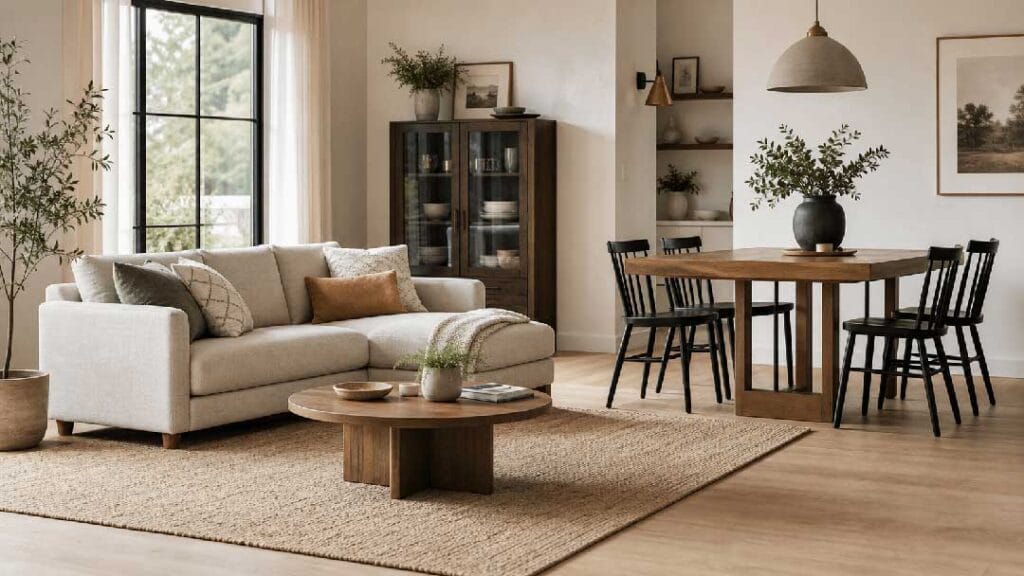
Traditional corner sofas, bulky and fixed in shape, are being replaced by modular sofas. Modular sofas consist of individual seat cushions, armrests, and backrests, which can be freely combined into straight, L-shaped, or island layouts, and even separated into individual seats. In terms of fabrics, technical fabrics and cat-scratch fabrics (wear-resistant and scratch-resistant) continue to be popular, while cotton and linen also have a stable customer base. Colors are shifting from dark gray and gray-green to cream and oatmeal colors, matching cream and natural wood styles.
Another trend is the emergence of 'recessed sofas' (with electrically adjustable backrests and footrests), no longer limited to home theaters, but also appearing in regular living rooms. However, be sure to check the location of any electrical outlets and ensure they are flush against the wall—most reclining sofas need to be a few centimeters away from the wall to recline. If you're on a budget, you can opt for a 'manually reclining' model, which offers better value.
2. Coffee table: From center to supporting role
In the trend of de-emphasizing the living room, coffee tables are rapidly shrinking in size. The combination of a small round side table and a movable, height-adjustable table has become standard. A height-adjustable coffee table can temporarily transform into a dining table or desk, and when not in use, it can be lowered to its lowest position without affecting the sense of space. In terms of materials, sintered stone countertops are popular (scratch-resistant and easy to clean), paired with solid wood or metal frames. Many people also use nested small round tables (one large and one small) for easy movement.
Buying Tips: Avoid glass coffee tables for small apartments – they take up too much space and easily leave fingerprints. Coffee tables with drawers are more practical, allowing you to hide remote controls, tissues, and other items.
3. Storage cabinets: A glamorous transformation for the TV wall
Many families are no longer opting for elaborate TV walls, instead using full-wall storage cabinets. The cabinet depth is kept between 35-45cm (too deep wastes space), with the upper half open for displaying books or decorative items, and the lower half with doors for storing miscellaneous items. The cabinet doors use a handle-less design (with push-to-open mechanisms or recessed recesses) to maintain a clean look. If a TV is to be retained, it can be embedded in the cabinet; the dimensions should be planned in advance.
If your ceiling height is less than 2.7 meters, it's not recommended to install a floor-to-ceiling cabinet, as it will feel oppressive. You can opt for a combination of low cabinets and wall-mounted cabinets, or a row of base cabinets (0.9 meters high) paired with wall shelves. The latter is more suitable for a minimalist style.
4. Armchairs and rugs: Enhance comfort and sophistication.
A single armchair (such as an Eames lounge chair, Windsor chair, or beanbag chair) is a focal point in the living room, creating a reading nook or prime movie-watching spot. The rug area should be based on the area in front of the sofa and not be too large. Wool blends and polypropylene are cost-effective choices; be sure to include a non-slip mat.
IV. Materials, Processes, and Environmental Protection: Consumers are becoming increasingly knowledgeable.
In the past few years, panel furniture has suffered from a poor reputation due to particleboard, but by 2025, oriented strand board (OSB) + MDI glue (formaldehyde-free) has become widespread in the custom furniture market. Consumers are no longer blindly pursuing solid wood, but are concerned about the environmental protection level of the board (national standard ENF level, Japanese F☆☆☆☆), as well as the durability of the surface finish (PET skin-feel, PVC film, paint, etc.).
In the solid wood furniture sector, black walnut, cherry, and white oak are the mainstream choices for mid-to-high-end furniture. A noteworthy craftsmanship is the hybrid structure of mortise and tenon joints and metal connectors—preserving traditional aesthetics while addressing the stability of large pieces of furniture (such as large bookshelves). Cracking is an unavoidable issue in solid wood furniture, but its probability can be reduced by controlling the moisture content (81% TP3T-12% TP3T) and using finger-jointing techniques. When purchasing, clarify whether expansion joints are included.
Another consumer trend is the resurgence of vintage furniture. Many young people are finding mid-20th-century Danish or Japanese furniture and mixing it with Scandinavian or wabi-sabi styles. However, vintage furniture is expensive and requires professional maintenance. For those with a limited budget, consider replicas—many domestic factories produce similar models using the same wood and craftsmanship, at only a third of the price of the original.
V. Price Range and Distribution Channels: Differentiation under Rational Consumption
The furniture market in 2025 showed a clear consumer segmentation. Leading brands (such as Nordic Style, Zaozuo, Herman Miller, etc.) still have a loyal customer base in first- and second-tier cities, but more people are turning to 'online mid-to-high-end white-label' brands - that is, factory direct sales merchants with design and quality but no brand premium, mainly attracting traffic through Xiaohongshu and Douyin, and completing transactions on Tmall or private domains.
Another channel is "factory direct + live streaming". Consumers can buy a genuine solid wood (finger-jointed) dining table for 1,000-2,000 yuan, while brand stores may price it at 4,000+ yuan. However, quality control and after-sales risks coexist, so it is best to see the actual product or request a sample to confirm whether the wood and paint finish are as described.
Price reference (for the average consumer):
- Modular three-seater sofa (tech fabric): 2000-4000 yuan; add 1000-2000 yuan for electric function.
- Solid wood + sintered stone combination coffee table: 1500-3000 yuan
- Full-wall storage cabinet (custom-made, projection area approximately 15 square meters): 8000-15000 yuan (particleboard), double the price for solid wood.
- Single lounge chair (cotton/linen/tech fabric): 800-2000 yuan
Mattresses are also relevant to the living room (some families place folding sofa beds or Murphy beds in the living room). Current mainstream mattresses feature individually pocketed springs plus multiple layers of foam/memory foam. Consumers are increasingly focusing on 'breathability' and 'edge support'. Mattresses using 3D materials (woven polyester fibers) as the support layer are becoming popular, claiming to be washable, but market acceptance remains to be seen.
VI. Three Pain Points in Living Room Consumption in 2025
First, size and delivery issues. Inaccurate size measurements are a major reason for returns when buying furniture online, especially with popular sofas that often appear larger in pictures than in reality. Buyers are advised to use tape to mark the actual area the furniture will occupy in their living room before placing an order, and also measure the width of the elevator/staircase door.
Second, color clashes in soft furnishings. Many items look good individually, but when piled together, they create a messy look. In 2025, a safer approach is to use low-saturation color schemes: light walls, medium-toned floors, and dark furniture, or light walls and floors with dark furniture. Limit accent colors to 10% per area. If unsure, use a color chart app to simulate color combinations.
Third, a balance between environmental protection and comfort is needed. Solid wood often has an odor when painted, and while environmentally friendly water-based paint is good, its hardness is not as good as PU paint. Ventilate the wood for at least a month during storage, or use a ventilation system.
VII. nkfurn and Furniture Selection
In an era of information overload in consumer decision-making, a platform that focuses on the furniture product itself, spatial arrangement, and material craftsmanship can often help users filter out the noise. nkfurn is such a platform, continuously compiling practical information such as changes in living room layouts, differences in sofa fabrics, and the environmental friendliness of custom cabinets, helping consumers and industry professionals to more easily understand the market and choose furniture that truly suits their needs.
Further Reading
If you are systematically planning your furniture selection or market content, you can also continue reading these related articles: