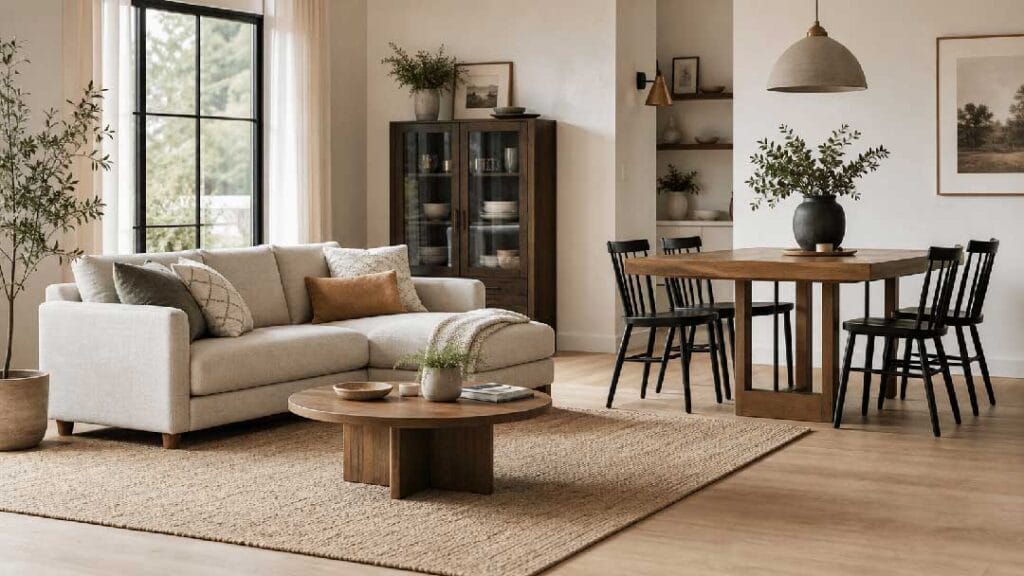
The adoption of sintered stone dining tables in Chinese homes has been faster than most other furniture categories. From the initial "Italian imported sintered stone" tables costing tens of thousands of yuan in specialty stores, to now where a table and four chairs can be purchased for three or four thousand yuan, this category has completed the process from concept to widespread adoption in a short period of time. Precisely because of this rapid adoption, the first batch of users who made concentrated purchases have now used their products for more than two years, and some issues that were initially obscured by specifications and sales pitches are beginning to surface in daily use.
Interestingly, very few people mentioned "cracked slabs" in the feedback. What's truly annoying are often things under the countertop, the finishing of edges and corners, and usage habits that weren't mentioned at the time of purchase. This article aims to discuss these issues that only become apparent after two years of use.
The slab itself rarely breaks; the problem usually lies with the layer underneath.
First, establish a basic understanding: sintered sintered stone is a material with a Mohs hardness of around 6. Its claims of high temperature resistance, acid and alkali resistance, and resistance to staining are largely true. However, its weakness lies in its flexural strength—high hardness means brittleness. A large, thin slab without reliable support in the middle will deflect under stress. Over time, repeated stress may not manifest as fracture, but rather as hollowness, abnormal noise, or localized subsidence.
Therefore, the lifespan of a sintered stone dining table is largely determined not by the sintered stone itself, but by the tray. There are several common types of trays available on the market:
- Multi-layer solid wood palletIt has good nail-holding power and a solid feel, but it is susceptible to water damage and may swell if the edges are not properly sealed.
- MDF palletLow cost and good flatness, but once water gets in, it is almost impossible to recover, and the expansion will push the countertop up.
- honeycomb aluminum support plateLightweight, moisture-proof, and non-deformable, but with higher cost, it is commonly found in mid- to high-priced products.
- glass trayThis was an early practice, now less common, because it was heavy and would fail completely upon impact.
If, after two years of use, issues such as "a hollow sound when tapped," "a slight sinking sensation when heavy objects are placed on the table," or "repeatedly loosening of the table leg screws" occur, it's most likely not a problem with the sintered stone slab itself, but rather an aging of the adhesive layer between the support plate and the sintered stone slab, or warping of the support plate itself due to moisture. These problems are particularly concentrated after the rainy season in southern China.
Chipping and scratches: the two most common types of damage in real-world use.
Among complaints about slab dining tables, chipping is far more frequent than cracking. Chipping is concentrated in several locations: the four corners of the countertop, the chamfered edges, and expansion joints and seams. The causes are often not "chipped while chopping vegetables," but rather bumps and knocks during transport, impacts from chair backs, dropped pots and pans, and hidden damage that existed during installation.
Here's a detail easily overlooked when buying products—the edge treatment. Straight edges, beveled edges, rounded edges, and rounded corners—different processes significantly affect the impact resistance of the edges. The thinner and sharper the edge, the more prone it is to small chips after a bump; while edges with a rounded transition, although they may not look as "high-end," are actually much more durable. Some low-priced products, in an effort to create a slim and lightweight feel, grind the edges very thin, making them look sleek but actually quite fragile.
Lower your expectations regarding scratches. While sintered stone is highly durable, everyday items like ceramic bowls and plates, the bottoms of earthenware pots, and cast iron pots are not insignificant in hardness. Repeated dragging will leave subtle matte marks, especially noticeable on dark-colored, glossy sintered stone. Matte surfaces tend to look better over time, with minimal change in overall texture; glossy surfaces, on the other hand, will appear dirty under side lighting if they have fine scratches.
One more point: many products on the market labeled "sintered stone slabs" are actually large-format ceramic tile slabs. The difference between the two lies not in appearance, but in water absorption, consistency, and body density. Large-format ceramic tile slabs are not unusable for countertops, but the requirements for thickness, backing, and edge finishing are higher, and the price should be lower. When buying, asking about the thickness and origin of the slab is much more important than looking at the color of the sample.
Where exactly does the price difference between over three thousand and over ten thousand go?
The price range for slab stone dining tables is quite wide, ranging from around 2,000 RMB for a table and four chairs online to over 15,000 RMB for a set in a physical store. Breaking down the price differences, they can be roughly categorized into several aspects:
| Item | Common practices in low-price segment | Common practices in mid-to-high price range |
|---|---|---|
| Plate thickness | 9mm or 12mm, reinforced by a support plate. | 12mm and above, some pieces are made to 15-20mm throughout. |
| Surface treatment | Ordinary inkjet printing results in a noticeable repetitive texture. | Dry grains, textured surface, continuous pattern matching |
| pallet | MDF or thin plywood | Thickened multilayer board, honeycomb aluminum |
| Corner treatment | Simple straight edges, rough chamfers | Fine chamfering, rounding, and edge binding processes |
| Table frames and hardware | Thin-walled pipes, standardization of connectors | Thickened profiles, custom structural components |
| Logistics and Installation | Direct shipping via express; users assemble themselves. | Dedicated logistics line, on-site installation by technicians |
The factors that truly affect the lifespan of a table are the tray, edge treatment, and frame structure, while surface texture and continuous grain effect primarily impact the visual experience. Consumers are most easily drawn to the texture in a store, and most easily overlook the tray, which can only be seen by flipping the table over.
It's worth noting that while low-priced online options aren't necessarily bad, there are two caveats: first, you'll likely need to assemble them yourself, and the precision of the installation directly impacts future issues like rattling and loosening; second, disputes can easily arise over liability for damage during shipping, as sintered stone is a typical product category with a high breakage rate, making packaging a crucial variable.
It looks good under the store lights, but the color seems off when I get home.
Many complaints about color differences in slab dining tables are not due to product issues, but rather to lighting problems. Stores generally use high color rendering and high brightness spotlights, which magnify the texture and luster of the slab, making it appear translucent and high-end. However, under natural light and warm-colored main lights at home, the same slab may appear grayish, cold, or even have a flat texture.
Dark-colored slabs show this more clearly. Black, dark gray, and dark brown slabs have clear textures under the spotlights in stores, but in restaurants with less natural lighting, they easily become a dull, dark mass. In contrast, lighter colors and low-saturation beige and light gray are more reliable and have a higher tolerance for changes in lighting.
A more practical approach is to request a small sample of the product, take it home, and examine it under the actual lighting in your dining room—once during the day and again at night with the lights on. Stores willing to provide samples are usually quite confident in the quality of their own boards.
Where is after-sales service located after two years of use?
Based on user feedback, two years is a watershed moment. Problems within the first six months are mostly caused by installation and logistics, while structural aging begins to appear around two years: the tray expands due to moisture and lifts the tabletop, the screws at the joints of the table legs repeatedly loosen, dust accumulates in the expansion joints and becomes difficult to clean, and some products experience slight delamination between the tabletop and the tray, resulting in hollow noises.
Most of these problems are repairable, provided that the structural design allowed for some flexibility. For example, is it easy to re-glu the tabletop and tray? Do the table legs have adjustable feet? Are the expansion joints fitted with replaceable filler strips? Some products that pursue extreme thinness and lightness make the structure too compact, thereby sacrificing room for later maintenance.
This also explains a phenomenon: within the same price range, dining tables that appear "bulkier" in structure tend to last longer. Furniture isn't a mobile phone; being lightweight and thin isn't always an advantage here.
To determine whether a stone slab dining table is worth buying, consider these points.
If you are currently choosing, a few actions that do not rely on professional equipment are more effective:
- Tap the four corners and the center of the tabletop; the sound should be consistent throughout. If any part sounds hollow, it indicates poor adhesion.
- Examine the side of the work surface to see if you can clearly see the cross-section of the board. Products with high density throughout or in the blank have a uniform cross-section.
- Run your hand over the chamfered corners to check if the transition is smooth and if there are any minor chips or burrs.
- Push the table to observe whether it wobbles or whether there is obvious deformation at the connection between the table legs and the tabletop.
- Ask about the material and thickness of the pallet, and whether it has been treated for moisture protection.
- Make sure there is sufficient allowance for expansion and contraction between the countertop and the tray, especially for large countertops.
Furthermore, slab dining tables are not suitable for directly chopping vegetables or bones on the surface, nor is it recommended to place pots that have just been removed from the heat directly on them—although they are heat-resistant, the stress changes caused by sudden temperature changes are not good for large, thin slabs. These usage habits are often not mentioned by the sales team, but they determine the condition of the table two years later.
After the slab slab craze subsides, where is the market headed?
From a product lifecycle perspective, slab stone dining tables have moved beyond the stage of relying on conceptual premiums. Early narratives of "imported slab stone" supported high prices, but now consumers are more concerned with specific parameters such as thickness, support panels, and edges, and prices are beginning to reflect structural costs. This has a significant impact on distributors' product selection logic: in the past, they sold the story of the slab material; now they sell the reliability of the entire table, and after-sales costs are becoming an increasingly important factor in store profits.
Another change is the segmentation of market segments. Small apartments are being promoted with extendable and foldable slab dining tables; large apartments and upgraded housing are being promoted with large slabs featuring continuous patterns and a strong sense of unity; while commercial and rental properties are prioritizing durability and low price. The same material has completely different structural requirements in different scenarios, and the approach of using the same sales pitch to target all customer groups is becoming ineffective.
For consumers, this is actually a good thing. The more mature the market and the more transparent the specifications, the easier it is to buy solidly built products at reasonable prices. What we really need to be wary of is not low prices, but rather cutting costs on unseen components like trays and corners.
Choosing furniture is never just about the name of the material. The same piece of sintered stone, paired with different backings, edge treatments, and table frames, can result in vastly different user experiences than differences between brands. nkfurn continuously monitors the materials, craftsmanship, spatial design, and market changes in furniture products, compiling the structural logic behind each category and real-world user feedback. This helps readers understand how a table is made before placing an order, and also provides industry professionals with a reference point when selecting and pricing products.
Further Reading
If you are systematically planning your furniture selection or market content, you can also continue reading these related articles:
- Identification and Appreciation of Agarwood
- Nankang Furniture Industry: A Complete Guide to the World’s Largest Solid Wood Furniture Manufacturing Base
- Common Solid Wood Furniture Materials Compared: Oak, Walnut, or Beech — How Should You Choose?
- Waterborne Coatings: Shaping a New Path for Green Manufacturing in Nankang Furniture
- Dual Exhibitions, United Momentum in Nankang! 2026 Nankang Spring Furniture Purchasing Festival & 4th Green Supply Chain Expo Grandly Opening on March 18!