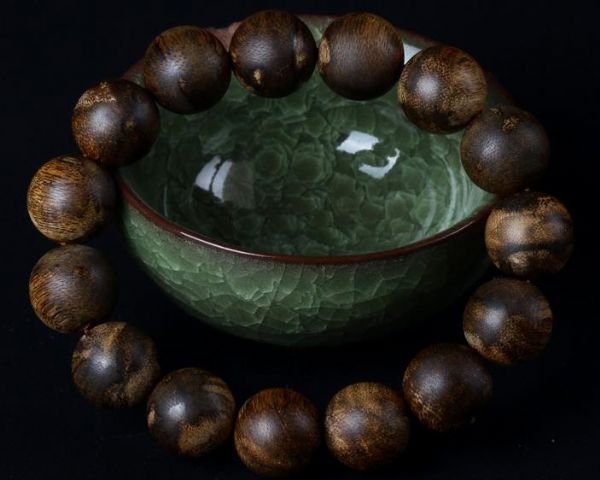
Agarwood, also known as "sinking incense" or "water-sinking incense", was written as "沈香" in ancient Chinese (沈, pronounced the same as 沉).
The "agarwood" in the ancient saying "agarwood, sandalwood, dragon's blood, and musk" refers to agarwood. Agarwood has an elegant fragrance and is extremely rare, and has been regarded as the king of all fragrances since ancient times.
Unlike sandalwood, agarwood is not a type of wood, but rather a solid concretion formed by a special type of fragrant tree, a mixture of oily (resin) and woody components. The wood of these trees themselves has no special fragrance and is relatively soft. Current research indicates that several trees in the genus *Aquilaria* of the Thymelaeaceae family, such as the Malayan agarwood tree, the Chinese agarwood tree, and the Indian agarwood tree, can produce agarwood.
Generally speaking, the greater the density of agarwood, the more resin it contains, and the better its quality. Therefore, the ancients often classified agarwood into different grades based on whether it sinks in water: those that sink in water are called "sinking" agarwood; the next grade, those that float halfway are called "stack agarwood" (stack refers to a woven bamboo or wood material), also known as "paper agarwood" or "water-playing agarwood"; and the next grade, those that float slightly on the surface of the water are called "yellow ripe agarwood".
Because agarwood is formed naturally, it varies greatly in size and shape. The ancients gave it many interesting names based on these characteristics, such as: Tooth Fragrance (small in size, shaped like a horse's tooth), Leaf Fragrance (thin flakes), Chicken Bone Fragrance (hollow inside, resembling a chicken bone), Glossy Fragrance (its appearance resembles withered mountain rocks, mostly used for display), Water Basin Head (very large in size but relatively soft in texture), and "Quick-Relieving Fragrance" (harvested before the agarwood has naturally matured), etc. Some cleverly shaped agarwood pieces can also be used as decorative items.
Agarwood must be stored in a dry place, away from direct sunlight. If it accidentally gets wet, wipe it dry with a clean cloth as soon as possible and let it air dry naturally; do not use heat to dry it.
The synthesis cycle of agarwood resin is very long, requiring 10-20 years for artificial synthesis, and only agarwood with low resin content can be produced. High-quality agarwood is not easy to obtain and its price is increasingly expensive, so careful identification is necessary when purchasing it.


Identification:
First, observe: Generally, agarwood is dark brown. When raw, it is as black as ink; when mature, it is as heavy as gold. Qinan (a type of agarwood) is as hard as gold, as smooth as jade, and as fragrant as honey. Otherwise, it is fake.
Second, smell: This is the most important method of identification. Generally, the smell of agarwood initially resembles a familiar medicinal scent, but upon closer inspection, one cannot quite place what it is. The key to identifying genuine agarwood is its "penetration," meaning the aroma of real agarwood travels along thread-like paths into the nose. To verify this, simply burn some live agarwood and carefully observe the path of the smoke; the smoke disperses in wispy strands.
Thirdly, touch it: Genuine agarwood becomes darker and shinier the more you wear it. Second-grade agarwood may appear to have a layer of oil, but it won't leave your hands dirty or oily to the touch. Fake agarwood will leave a mark on your hands. There are also fake agarwood products on the market made by soaking miscellaneous wood in medicinal solutions and fragrant oils; when identifying genuine agarwood, sinking in water does not necessarily mean it's genuine.
Fourth, if you still can't tell the difference between real and fake after the above three steps, then we can use an open flame to burn it directly and smell its aroma, or use an electric incense burner to take a small piece and smell it directly. Then you will definitely realize whether it is real or fake. The aroma of real agarwood is pure and simple, while fake agarwood often has a chemical fragrance or a relatively turbid non-agarwood aroma.

Agarwood can be divided into four categories based on the different reasons for resin formation:
Firstly, "ripe resin": After a tree dies, its roots and trunk fall to the ground or sink into the soil. Over the years, exposed to wind and rain, they slowly decompose and shrink, eventually leaving behind a concretion mainly composed of oils. As recorded in the Compendium of Materia Medica: "Old trees that have been stored for many years, whose outer bark has rotted away but whose heartwood and branches remain intact, and which are hard, black, and sink in water, are agarwood."
Secondly, "living resin": resinous resin formed while the tree is still alive. When the tree is wounded by external forces such as axes, snakes, insects, or animals, it will exude resin as a form of self-protection, thus forming resinous resin near the wound.
Thirdly, "fallen branches" refers to the incense that forms after the branches have decayed and fallen.
Fourth, "insect-damaged" refers to the fragrance formed due to the erosion of trees by tree insects, bacteria, etc.
Because young agarwood trees lack sufficient resin glands, only trees that are several decades old or older can form agarwood. Moreover, it takes many years from resin formation to maturity, making top-quality natural agarwood priceless.
For most agarwood, the darker the color and the denser the texture, the better the quality. However, this is only a general standard. Due to the complex formation of agarwood, many factors such as the length of time it has been in formation, the amount of oil it contains, and whether it is from a living or dead tree directly affect the quality of the incense. Therefore, relying solely on appearance and physical indicators is insufficient for identification. The best way is to burn it and judge it by smell and experience.
Agarwood identification:
1. Chemical identification method:
A small amount of the alcohol-soluble extract of genuine agarwood is sublimated to obtain a yellowish-brown oily substance with a strong aroma. Adding one drop of hydrochloric acid and a small amount of vanillin granules to the oily substance, followed by 1-2 drops of ethanol, gradually produces a cherry-red color that deepens upon standing; counterfeit agarwood does not exhibit this characteristic.
2. Spectroscopic identification method:
The ultraviolet absorption spectrum of genuine imported agarwood shows an absorption peak only at (206±2) nm, while imported counterfeit agarwood and domestic agarwood show three absorption peaks at (206±2), (267±2), and (282±2) nm, respectively, although the latter two peaks contain less information. Looking at the first derivative spectrum, domestic agarwood has a large characteristic peak at (267±2) nm, while imported counterfeit agarwood has a large absorption peak at 242 nm. Genuine imported agarwood has no absorption peaks in this range, while counterfeit agarwood shows no absorption peaks in any of these areas. These differences in spectra indicate differences in composition and quality.
3. Chromatographic identification method:
The ethanol extract of sample 95% was collected by micro-sublimation to obtain a brownish-yellow volatile oil. The oil was dissolved in acetone and spotted onto a silica gel G thin-layer plate, and developed with benzene-acetone (9:1). Under 365nm UV light, the genuine product showed 4 spots, while the counterfeit product showed none. When developed with concentrated sulfuric acid solution of 5% vanillin, the genuine product showed 8 spots, while the counterfeit agarwood showed none.