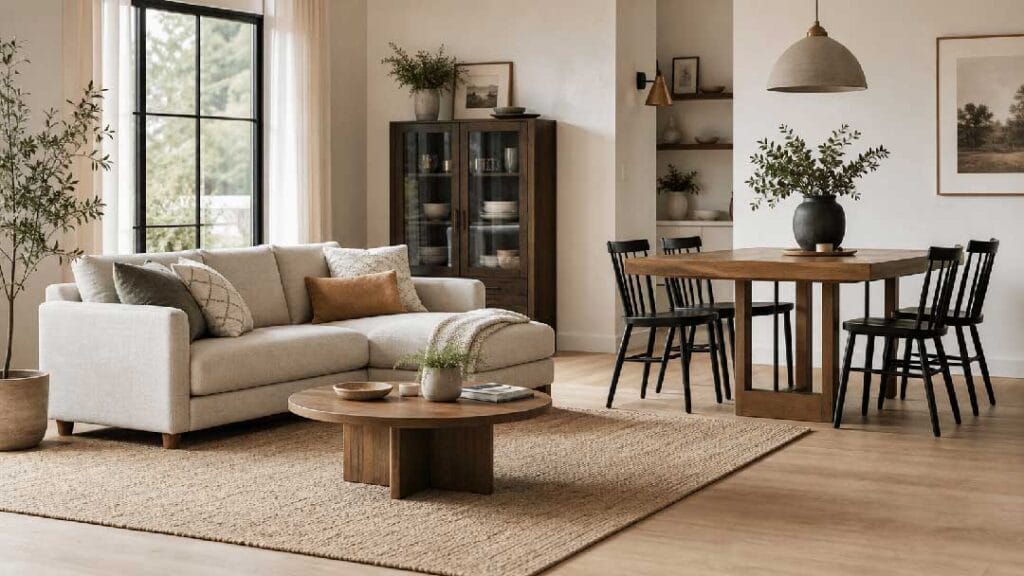
Asking "Is this pure solid wood?" in a store often yields a string of phrases like "solid wood frame," "multi-layer solid wood board," and "solid wood veneer." Consumers' confusion doesn't stem from not understanding the terms, but from the fact that these words are all under the same "solid wood" label, yet the prices differ by more than double. The same dining table, priced at 3,000 and 12,000, might look similar under showroom lighting, but upon closer inspection, the base material, veneer thickness, number of coating layers, moisture content control, and after-sales repair probability are completely different systems. The price difference doesn't come out of thin air, nor is it entirely from "brand premium"; it's hidden in several aspects that can be verified item by item.
“In contracts, "solid wood" has more than one meaning.
In domestic technical standards for wooden furniture, there are distinctions between solid wood furniture, solid wood veneer furniture, and composite wood furniture. The core difference lies in "where the solid wood is used, what proportion it accounts for, and whether the surface is a thin layer of solid wood veneer." However, in actual sales scenarios, this classification is often simplified to a single word. The product details page that consumers see states "solid wood," but the actual product may be a solid wood panel frame with a multi-layer board cabinet, or it may be a MDF substrate with a layer of natural wood veneer on the outside, visually appearing as wood grain.
The key to this matter is not whether the merchant lied, but rather...Granularity of expressionA well-written contract should answer four questions: what species of wood is the main material, whether the base material is solid wood plywood or engineered wood, whether the surface is solid wood veneer or melamine finish, and what environmental protection level it adheres to. If these four points are clearly stated, there is a benchmark for price comparison; if they are unclear, the buyer and seller are likely to get entangled in disputes over discrepancies between the goods and the description later on.
Substrate: The First Watershed in Cost
Solid wood panels
From logs to finished, varnishable panels, the process involves numerous steps, including cutting, drying, curing, defect removal, finger-jointing or straight splicing, and sanding. Drying and curing are the most easily overlooked by consumers, yet they account for the largest cost. Inadequate moisture control in the wood can lead to cracking and warping during the heating season in northern China and the humid weather in southern China. Reputable factories maintain a stable moisture content for their sales regions, typically fluctuating between 8% and 12%, adjusting according to the specific area. Cheaper products often omit this time and equipment costs.
Another factor is the yield rate. Logs have knots, sapwood, and color variations. From a wide plank, only sections with continuous grain and similar color can be selected; the rest can only be used for short pieces or finger-jointed. The material cost of a tabletop made from wide planks is naturally higher than that of narrow planks, which is why solid wood tables of the same size can differ in price by several thousand.
plywood and blockboard
Multi-layer boards are made of an odd number of layers of veneer glued together in a cross-grain pattern. They offer good stability, minimal deformation, and reasonable nail-holding power, hence the term "solid wood multi-layer board." While they do contain wood, they are not the same as "a single piece of solid wood." Plywood, on the other hand, consists of wood strips joined together in the middle and veneers on both sides. It is less expensive, and its flatness depends on the quality of the core material. This type of substrate is very common for cabinet bodies, drawer bottoms, and back panels, and is a well-established practice.
MDF, particleboard with veneer
This type has the greatest cost advantage: the substrate is flat, can be carved into shapes, and is suitable for large flat pieces. The surface can be covered with natural wood veneer, engineered wood veneer, or directly pressed with melamine paper, PET film, or excimer finish. Most of the "solid wood veneer furniture" that consumers talk about falls into this category, or in the middle ground of "multi-layer board with wood veneer." Its shortcomings are not in appearance, but in repairability and load-bearing parts: once the substrate is exposed due to a bump, the repair difficulty is significantly higher than that of solid wood; the connection points that require repeated disassembly and assembly and bear weight also rely on hardware and structural design to compensate.
Surface Finishing: The Thickness of the Veneer Determines Fate
The common thickness of natural wood veneer is between 0.2 and 0.6 millimeters. Thin and thick veneers have completely different feels, impact resistance, and number of sanding cycles. Thin veneers are cheaper and easier to apply, but they are prone to peeling and glue seepage when the edges are stressed. Thicker veneers can withstand light sanding and color correction, and can be salvaged if problems arise. Many price differences are hidden in these fractions of a millimeter, and this difference is almost invisible in a showroom.
Engineered wood veneer offers another approach. It's made from fast-growing timber through dyeing, reconstituted processing, and slicing, resulting in regular grain, minimal color variation, stable supply, and lower costs than natural wood veneer with equivalent visual appeal. For custom projects seeking consistent wood grain throughout the entire house, engineered wood veneer is actually more practical, as it's difficult for natural wood veneer to achieve large areas without color variation.
The coating process is the second major cost pitfall. Open-pore finishes preserve the feel of the wood pores but require high-quality substrate and sanding; closed-pore finishes offer strong coverage and tolerate more imperfections; wood wax oils provide a good texture but offer weak protection, requiring regular maintenance from the user. For the same product, the cost difference between three coats of base coat and two coats of top coat and five coats of base coat and three coats of top coat is significant, and there are also real differences in feel and stain resistance—this isn't some mystical concept.
Lay out the money: a statement of accounts
| Cost items | Solid wood panels | engineered wood substrate with solid wood veneer |
|---|---|---|
| Raw material utilization rate | Low, wide plate material handling loss is large | High quality, uniform board specifications, and can be nested. |
| Drying and Health Preservation | It is necessary, has a long cycle, and accounts for a significant portion of the cost. | Substrate production has stabilized; production processes have been moved upstream. |
| Panel splicing and sanding labor | Many processes, high proportion of manual labor | The work mainly involves pressing and edge sealing, with a low proportion of manual labor. |
| Painting | Color difference, knots, and putty need to be addressed. | Good finish consistency and low painting pressure |
| Risk of deformation and cracking | High, dependent on moisture content control | Low, but susceptible to water, moisture, and damage from impacts. |
| Logistics and Installation | Heavy, resulting in high handling damage and shipping costs. | Lightweight, flat-packed and user-friendly. |
| Repairability | It can be sanded, touched up, and repainted. | After damage, only the affected area is usually replaced. |
This table leads to a less "biased" conclusion: the cost advantage of solid wood lies not in production efficiency, but in its lifespan and repairability; veneer panels offer advantages in stability, controllability, and scalability. Both approaches have their valid scenarios; the problem lies only in…Selling veneer products at solid wood prices using the cost of veneer, or selling veneer products using the same sales pitch as solid wood..
What can you actually buy with different budgets?
Most "solid wood" dining tables and bookshelves in the thousand-yuan range are made of fast-growing woods such as pine and rubberwood, or have solid wood frames with artificial board tabletops. The panels are narrow, the color difference is obvious, and the paint is simple. They are entry-level choices and it is normal for them to last three to five years without major problems, but don't expect them to have a stable wide tabletop and a delicate feel.
The price range of several thousand to ten thousand yuan is the most competitive. In this segment, you can buy finger-jointed or straight-jointed oak, ash, and cherry furniture, as well as well-made custom cabinets made of multi-layered plywood with natural wood veneer. Which you choose depends on whether you prioritize "the material itself is solid wood" or "a unified look throughout the house, precise dimensions, and controllable after-sales service." In a whole-house customization scenario, using multi-layered plywood for the cabinet body and solid wood or thick wood veneer for the doors is a very practical combination.
For orders over 10,000 yuan, consumers start paying for wider planks, better materials, superior mortise and tenon joints, higher-quality finishes, and better after-sales service from the brand. At this price point, it's crucial to be wary of situations where "the price goes up, but the craftsmanship doesn't keep up"—using narrow strips of plywood to imitate wide planks, using engineered wood veneer to impersonate rare wood species, and using sealing paint to cover color differences and filler—all of these represent paying money for something that doesn't match the price.
Skin grafts are not a sin: which areas are actually more suitable?
Large-area flat cabinet doors are a prime example. A single solid wood panel over two meters high is significantly more prone to warping under humidity changes than a stable substrate. It may look nice, but it's worrisome to use. Using multi-layered boards with thick wood veneers offers better flatness and dimensional stability; this is a rational approach, not a matter of cutting corners.
The same applies to cabinet side panels, back panels, and drawer bottoms. These parts are rarely stressed, bear no weight, and are not frequently touched, so using a stable base material is more cost-effective. Conversely, parts that need to bear weight and experience repeated stress should be made of solid wood: chair legs, table legs, bed crossbars and stiles, mortise and tenon joints, and tabletops and shelves that require on-site cutting. When purchasing, focus on these "structural parts" rather than just looking at the grain of the door panels.
Several hard methods for on-site judgment
- Look at the end faceThe cross-section of the board reveals its layers; plywood has clear layer lines, MDF has uniform fibers, and solid wood panels have wood grain extending to the ends. Sample sections are usually available in the sample room; feel free to ask for them to see.
- Check if the texture is repeated.The grain patterns of adjacent panels of natural wood veneer will not be exactly the same; if the patterns of two door panels are almost identical, they are most likely printed finishes or engineered wood veneers.
- Check the color difference and seams of the panels.For wide, straight-jointed tabletops, color differences are permissible, but the seams should be tight and flat. If the color difference is completely covered by a large area of filler and dark paint, you should ask why.
- Check the edge bandingWhether the edge banding is flush with the board surface, whether there is excess glue, and whether the corners are chipped directly reflect the factory's processing precision.
- Back and inside of drawerThe fact that the front is meticulously designed while the back is rough indicates that cost control is focused on areas that are not readily visible, which is common in low-priced products.
- Ask for the name of the base material and its environmental protection rating.Having someone write down the tree species, substrate type, finish type, and performance standards in the order is much more useful than a verbal promise.
- Confirm the usage environmentThe requirements for moisture content and structure differ for rooms with underfloor heating, coastal high-humidity areas, and northern heating seasons. Clarifying these requirements in advance can save a lot of trouble later.
Real-world problems for distributors and buyers
From the perspective of stores and project procurement, the biggest cost caused by the vague description of "solid wood" is not returns, but the loss of trust. If a customer moves in six months later and the door panels peel or the tabletop develops cracks, and then returns to the store, the only recourse is negotiation if the original contract didn't clearly specify the base material and finish. Conversely, if the contract clearly states that "the cabinet body is made of multi-layered board with oak veneer, the door panels are solid wood straight-jointed, and the environmental protection standard meets a certain level," the customer is more likely to accept the price because they understand why they are paying that amount.
There's another layer to consider in engineering and turnkey projects: the consistency between samples and bulk orders. Wood veneer is a natural material, and color differences between batches are inevitable. The proper practice is to retain samples for comparison and agree on an acceptable range for color difference, rather than promising "exactly the same as the sample." Communicating this in advance can avoid a lot of rework later.
Finishing techniques are taking away business from solid wood.
In the past two years, the surface finishes of cabinet furniture have made rapid progress. Simultaneously, wood grain, skin-feel films, and excimer finishes have achieved a level of clarity and feel that "looks very much like solid wood from a distance." Combined with scratch resistance, no need for painting, and short delivery times, these finishes have created substantial competition for mid-to-low-priced solid wood furniture. Younger consumers are less fixated on "must be made from a single piece of solid wood," and are placing higher demands on precise dimensions, uniform color, and consistent delivery. This shift directly impacts product structure.
On the other hand, the value of solid wood furniture is being rediscovered: its repairability, polishability, and ability to retain their elegance even with signs of wear and tear over time are being re-emphasized in secondhand home renovations, old furniture refurbishments, and families seeking long-term durability. The market isn't tilting unilaterally to one side, but rather stratifying—cheaper options focus on finishes, more expensive options on materials and craftsmanship, and those in the middle are the most likely to struggle to define themselves.
For consumers, the actionable advice is actually quite simple: first, clarify whether the furniture is intended for "five years" or "fifteen years," then decide whether to spend money on materials or on craftsmanship and structure. For distributors and buyers, clear communication is more effective in retaining customers than simply lowering prices. Solid wood veneer and solid wood are not opposing forces; they each address different issues. What truly needs to be eliminated are vague descriptions.
nkfurn focuses on changes in furniture products, spatial design, materials, craftsmanship, and market information. It discusses details that are often overlooked, such as base materials, finishes, structure, and price range, to help readers ask the right questions before placing an order and to help industry professionals explain their products clearly.
Further Reading
If you are systematically planning your furniture selection or market content, you can also continue reading these related articles:
- OEM vs ODM Furniture Manufacturing: What’s the Difference?
- Is a smart bed worth buying? A complete breakdown of its features, price, and specifications.
- What are the differences between slab stone dining tables and marble dining tables? A real comparison from daily maintenance to long-term use.
- Common misconceptions about solid wood dining tables: Don't let sales pitches mislead your judgment.
- Nankang Furniture Industry: A Complete Guide to the World’s Largest Solid Wood Furniture Manufacturing Base