Rosewood furniture combines the beauty of Ming and Qing styles, featuring exquisite designs and sturdy structures. Each piece embodies traditional Chinese cultural elements and reflects the wisdom of craftsmen and designers. They serve both practical and aesthetic purposes, becoming an integral part of every piece of furniture.
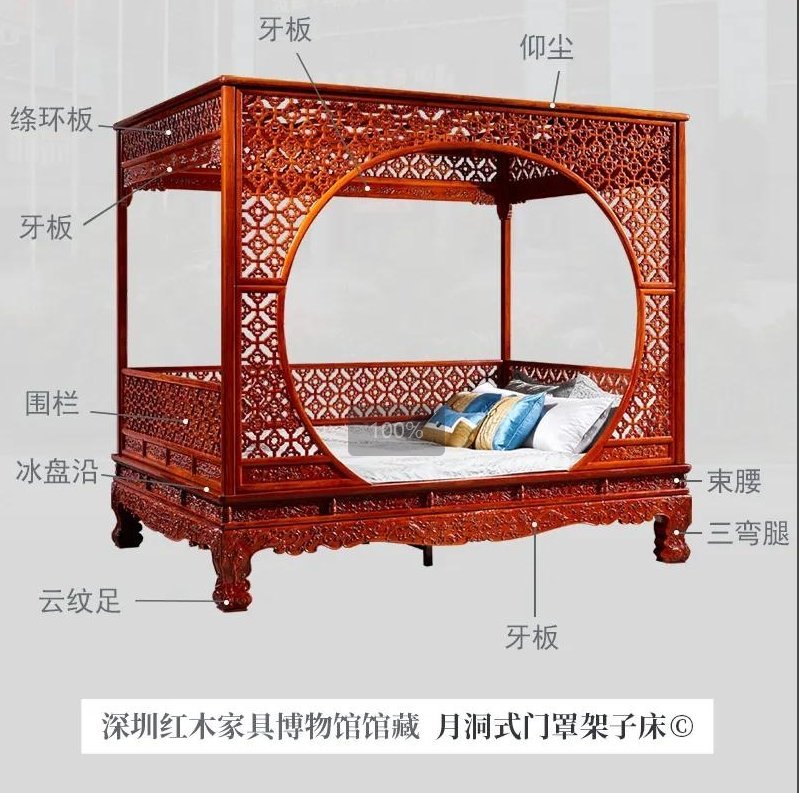
We will take eight pieces of furniture from the Shenzhen Rosewood Furniture Museum as examples to learn about the names of these common furniture components.

Glossary
1. Da Nao
The headrest is a structural component attached to the back of a chair, used to connect the uprights and the back panel. It is positioned slightly higher in the center and curls back slightly so that people can rest their heads on it when they are resting, hence the name headrest.

2. Waist corset
The "waist" refers to the recessed section between the frame and the apron in furniture, resembling the slender waist of a beautiful woman, hence the name. Waist sections can be high or low, and the waistline can be straight or concave. Waist-shaped furniture is an important characteristic of Ming-style furniture and a crucial factor in identifying classic furniture.

3. Stretcher
Stretchers are wooden strips that fix and connect table legs and tabletops, and are one of the main structural components of furniture. The most common type of stretcher is the straight stretcher. By the Ming Dynasty, more aesthetically pleasing designs such as the curved stretcher and the overlord stretcher emerged.

4. Tooth
"Yazi" refers to the decorative wooden strips used at the corners where the vertical and horizontal supports of furniture meet. The most common "yazi" in our daily lives is the auspicious cloud-shaped wood carving decoration at the corners where the tabletop and the four legs meet.

5. Ticket opening and circle opening
The "arch" or "extension" refers to the panel inlaid between the four uprights of furniture. It serves both aesthetic and decorative purposes, while also supporting the weight and enhancing sturdiness. Examples include the spaces between the legs of a chair and the front and back legs on either side of a table. These panels, often framed, have openwork designs in the center. The panels on the top three sides (left, right, and top) are called "arches," while those on the top, bottom, left, and right sides are called "circles."

These openings or rims are named after the hollow pattern in the center. If the hollow is shaped like a cusp, it is called a cusp opening; if the hollow is oval, it is called an oval rim, and so on.
6. Baffle
Side panels generally refer to various decorative wooden boards inlaid on the left and right sides of a table or between the front and back legs. Side panels not only reinforce the stability of the table legs but also serve as excellent decorative elements.

There are many different styles of baffles, the most common ones are cloud-shaped baffles, swastika baffles, gourd baffles, grass dragon baffles, lantern baffles, etc.
7. Short and old
It is a short and small vertical stretcher, often used on horizontal stretchers with a large span. The short stretcher is often used in conjunction with the curved stretcher. For example, the short stretcher is often used under the tabletop and on the horizontal stretchers around the table to support the tabletop and reinforce the four legs.

8. Mud support and tortoise feet
A base frame is added to the bottom of the four legs of a chair, stool, bed, or table, so that the legs do not touch the ground directly but rest on the wooden frame. This wooden frame is called a base frame. A tortoise foot is an improvement on the base frame, in which small, tortoise-shaped feet appear under the base frame, making four cute tortoise feet grow out of the otherwise plain round base frame.

“The emergence of the "mud support" not only changed the old form of the four legs directly touching the ground, creating a new aesthetic, but also reinforced the connection and stability of the four legs. Furthermore, the "turtle feet" design prevented the "mud support" from directly contacting the damp ground, while also ensuring ventilation within the round frame of the "mud support".
9. Legs and feet
As the name suggests, furniture legs are the upright wooden feet that support the furniture. Generally, furniture has four legs to support the seat and tabletop. Typically, furniture legs are shaped like three curves: they bend outwards from the waist, then curve inwards to converge at the bottom, and then curve outwards again, forming three curves. In addition, there are special types such as grasshopper legs, flared legs, panel legs, beaded legs, and scroll legs.

10. Consecration, Bright Foot and Ring Plate
"Opening the light" refers to carving out various patterns in the back of a stool or chair.

"Bright feet" refers to the various patterns carved into the lower part of the chair back, where it contacts the seat.

A "taohuan board" refers to a panel with raised lines on all four sides and openwork in the middle to form various patterns, which is used to inlay the waist of furniture or railings.

The emergence of openwork, bright feet, and ribbon-like panels breaks the monotony of whole panels and large-area panels, displaying a delicate and lively charm.
The names of components in classical furniture are generally simple and descriptive, showcasing the rich imagination and creativity of ancient craftsmen. Looking at actual pieces, it's easy to perceive their passion and deep love for furniture. This passion, passed down through interesting components and classic works, continues to inspire craftsmen in the new era..